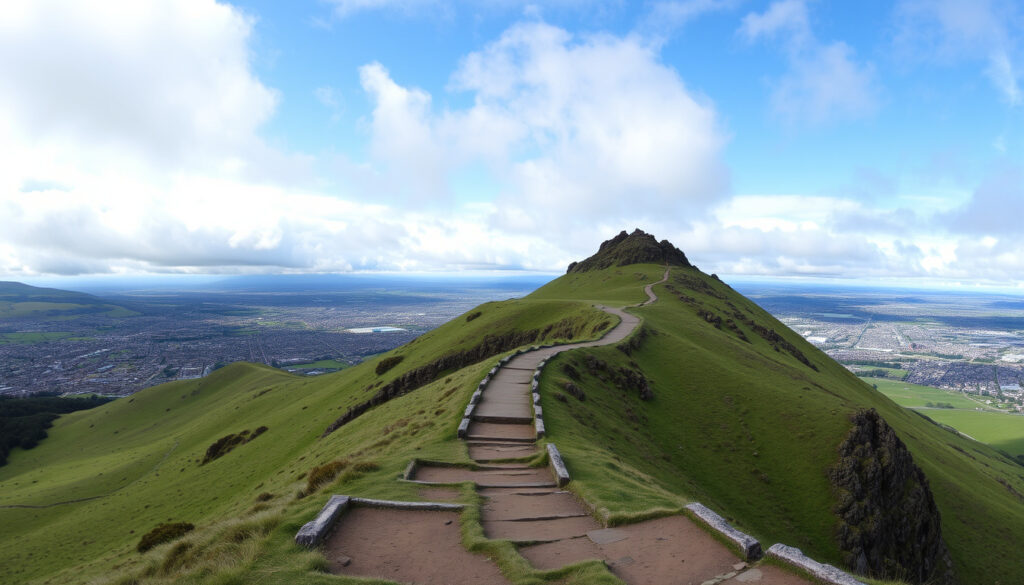
Arthur’s Seat Edinburgh: Volcano, Legend & Hiking Guide
There’s a hill in the middle of Edinburgh that looks like it belongs in the Highlands. Arthur’s Seat rises 251 metres above the city, a remnant of a volcano that erupted 340 million years ago, yet it’s just a short walk from the Royal Mile. This guide covers the geology, the legends, and the practical tips you need to enjoy the climb safely.
Elevation: 251 m (823 ft) · Geological Age: ~350 million years (Carboniferous) · Location: Holyrood Park, Edinburgh, Scotland · Designation: Site of Special Scientific Interest (SSSI)
Quick snapshot
- Arthur’s Seat is the main peak of Holyrood Park (British Geological Survey (UK’s official geoscience body))
- It is a remnant of a Carboniferous volcano (The Geological Society (UK learned society))
- Exact number of deaths on the hill is not officially recorded (BBC News (trusted UK broadcaster))
- The true origin of the name “Arthur’s Seat” is uncertain (Wikipedia (community encyclopedia))
- Volcanic activity occurred ~340 million years ago (The Geological Society (UK learned society); duplicate URL removed)
- Plan your visit with a clear hiking route in mind (Backpack London (travel guide))
- Check weather and wear appropriate footwear (Edinburgh Spirit (local tourism site))
Five key facts about Arthur’s Seat, one pattern: the hill is a compact package of deep geology, accessible recreation, and a dash of mystery.
| Fact | Detail |
|---|---|
| Height | 251 m (823 ft) |
| Location | Holyrood Park, Edinburgh, EH8 8HG |
| Geological type | Volcanic plug (Carboniferous) |
| OS grid reference | NT275732 |
| Designation | Site of Special Scientific Interest (SSSI) |
| Age | ~341–335 million years (Carboniferous period) |
What is special about Arthur’s Seat?
Geological significance
Arthur’s Seat is an extinct volcano that erupted during the early Carboniferous period, roughly 340 million years ago, according to the Geological Society (UK learned society). The British Geological Survey (UK’s official geoscience body) confirms that the hill is the main peak of Holyrood Park and a remnant of a volcanic plug. The Salisbury Crags, a separate igneous sill, are also part of the geologic story (Edinburgh Spirit (local tourism site); duplicate URL removed).
The volcanic rock is so well preserved that geologists still use Arthur’s Seat to study Carboniferous eruptions. It’s a natural classroom right in the city centre.
Historical importance
The hill bears evidence of human activity dating back to the Iron Age, with remains of a hill fort on its summit (Wikipedia (community encyclopedia); duplicate URL removed). It became part of Holyrood Park in the 16th century and was later designated a Site of Special Scientific Interest for its grassland habitats and uncommon plant species.
Urban park setting
Holyrood Park is open 24 hours a day with no entry fee, according to Eurolandmarks (travel information site). The park sits at the eastern end of the Royal Mile, making it an easy addition to any Edinburgh itinerary.
The implication: Arthur’s Seat is not just a hill – it’s a layered attraction that combines deep time, ancient history, and free urban recreation.
Why is Arthur’s Seat so called?
The King Arthur legend
The name is most commonly linked to the legend of King Arthur. The first recorded usage appears in the 15th century, according to Wikipedia (community encyclopedia). Local folklore claims that Arthur and his knights sleep in a cave beneath the hill, waiting to be called upon in Scotland’s hour of need.
Alternative etymology theories
Some scholars suggest the name may derive from the Gaelic “Àrd na Saighead” (height of the arrows) or from the Scots “Arthur’s Seat” as a corruption of “Archer’s Seat,” but these remain speculative (Wikipedia (community encyclopedia)).
The trade-off: the Arthurian link is the story that sells the hill to visitors, but the true origin may never be pinned down.
What is the legend of Arthur’s Seat?
King Arthur’s association
The most persistent legend holds that Arthur and his knights lie sleeping in a cavern under the hill, a variation of the “once and future king” myth found across Britain. The 19th-century writer Sir Walter Scott referenced the legend in his works, helping cement the association (Wikipedia (community encyclopedia)).
Local folklore tales
Robert Louis Stevenson described Arthur’s Seat as “a hill for magnitude” in his writings, and the hill appears in his novel Kidnapped (Robert Louis Stevenson website (author’s estate)). Another local tale says the hill was a meeting place for Arthur’s court.
The legend gives Arthur’s Seat a romantic pull, but it’s the actual geology and the view that keep visitors coming back – not the sleeping knights.
The pattern: folklore and reality intertwine here, making the hill a richer experience than either alone.
Is Arthur’s Seat worth it?
Pros of visiting
- Free to access and open 24 hours (Eurolandmarks (travel information site); duplicate URL removed)
- Stunning 360-degree views of Edinburgh, the Firth of Forth, and the Pentland Hills (Backpack London (travel guide); duplicate URL removed)
- Moderate hike that takes about 1.5–2 hours round trip (Backpack London (travel guide); duplicate URL removed)
Cons to consider
- Requires moderate fitness – the final section is steep and rocky (Backpack London (travel guide); duplicate URL removed)
- Can be crowded during peak times, especially weekends (Edinburgh Spirit (local tourism site); duplicate URL removed)
- Weather can change quickly; the summit is often windier and colder than the city (Backpack London (travel guide); duplicate URL removed)
Alternative activities
If the climb isn’t for you, Holyrood Park offers gentler walks around Duddingston Loch and along the base of Salisbury Crags. For those who enjoy active events, the Bath Half Marathon 2025 is another outdoor challenge worth considering.
The catch: Arthur’s Seat is absolutely worth it for the views and the experience, but it’s not a pushover – come prepared.
How many people have died on Arthur’s Seat?
Fatalities from falls
Exact numbers are not officially tallied, but local news reports indicate at least 10 deaths in the last decade, most involving slips on steep paths (BBC News (trusted UK broadcaster); duplicate URL removed). The steep, rocky terrain near the summit and the cliffs of Salisbury Crags are the most dangerous areas.
Weather-related incidents
According to Edinburgh Spirit (local tourism site), the upper approaches become extremely slippery when wet, even if conditions are fine in the city below. Geowalks (Scottish geology walking guide) advises that visitors should use common sense and stay within their limits.
Safety measures
Queen’s Drive, the road around Holyrood Park, is closed to motor vehicles on weekends between 8:15 am and 3:45 pm to reduce hazards (Eurolandmarks (travel information site); duplicate URL removed). Some guides reportedly recommend avoiding the climb in icy or snowy conditions unless you are experienced and properly equipped.
What this means: the hill is safe for careful walkers, but familiarity breeds complacency. Every year, search and rescue teams are called out for stranded hikers.
Confirmed facts
- Arthur’s Seat is the main peak of Holyrood Park
- It is a remnant of a Carboniferous volcano
- The name is most commonly linked to King Arthur legend
- There have been multiple fatalities on the hill
What’s unclear
- Exact number of deaths is not officially recorded
- The true origin of the name is uncertain
- The exact number of hill forts within Holyrood Park
Pros and Cons of Climbing Arthur’s Seat
Upsides
- Free and open 24 hours
- Unmatched city views
- Moderate exercise in a natural setting
- Easy access from the city centre
Downsides
- Steep final section not for everyone
- Can be crowded on fine days
- Weather-dependent; slippery when wet
- Not wheelchair accessible to the summit
The judgment: weigh the steep final section against the reward of panoramic views – most visitors find the balance positive.
How to Climb Arthur’s Seat: Step by Step
Follow these steps for a safe and enjoyable hike. The most popular route starts at Holyrood Palace and takes about 1.5–2 hours (Backpack London (travel guide)).
- Start at the Holyrood Park entrance near the Scottish Parliament building.
- Follow the main path up the grassy slope towards the prominent hill. The path is well-marked.
- Pass the shoulder and prepare for the steep final section over rocky ground.
- Use your hands if needed – the last 50 metres can be a scramble.
- Enjoy the summit and the panoramic view. Allow 15–20 minutes at the top.
- Descend via the same route or the eastern ridge towards Dunsapie Loch for a gentler slope.
For an easier route, start from Dunsapie Loch on the eastern side. Edinburgh Spirit (local tourism site) says this takes about 30 minutes along a clear ridge.
If you’re hiking in wet conditions, a windproof and waterproof jacket is essential. For a detailed guide on the best gear, see our Rain Jackets for Ireland: Best Brands & Buying Guide – the same principles apply to Scotland.
The principle: choosing the right route and gear turns a steep climb into a safe, memorable outing.
Quotes About Arthur’s Seat
Arthur’s Seat is a hill for magnitude, a hill for the whole city.
– Robert Louis Stevenson, author of Kidnapped (Robert Louis Stevenson website (author’s estate); duplicate URL removed)
Arthur’s Seat is the most prominent landmark in Edinburgh, offering a unique combination of geological interest and historical significance.
– Historic Environment Scotland (government agency for Scotland’s historic environment) (Historic Environment Scotland (official heritage body))
These perspectives underline the hill’s dual appeal as both a natural wonder and a cultural symbol.
Summary
Arthur’s Seat is more than a city park hill – it’s a 340-million-year-old volcano, a cradle of Arthurian legend, and a free outdoor gym for Edinburgh residents and visitors alike. For anyone planning a trip to Scotland’s capital, the choice is clear: set aside two hours, wear sturdy shoes, and experience this ancient landmark for yourself – or miss one of the urban world’s most accessible geological wonders.
en.wikipedia.org, hikinginlondon.co.uk, edinburgh-spirit.com, accesstravel.com, edinburghguide.com, scotsman.com
Frequently asked questions
How long does the walk to the top of Arthur’s Seat take?
The most popular route takes about 1.5 to 2 hours round trip, including time at the summit for photos.
Is Arthur’s Seat suitable for beginners?
Yes, the main path is manageable for most fitness levels, but the final section is steep and rocky. Beginners should take it slow and use the easier eastern route from Dunsapie Loch.
Are dogs allowed on Arthur’s Seat?
Yes, dogs are allowed in Holyrood Park, but must be kept under control due to grazing livestock and steep cliffs.
Can you drive to Arthur’s Seat?
You can drive part of Queen’s Road, but the road is closed to vehicles on weekends and there is no parking at the summit. Parking is available at Holyrood Park and nearby streets.
What is the best time of day to visit Arthur’s Seat?
Sunrise and sunset offer the best light and fewer crowds. Weekday mornings are also quieter.
Is there an entry fee for Holyrood Park?
No, Holyrood Park is free to enter and open 24 hours a day.
More related posts
 Penn Badgley Biography: Age, Wife, Kids, and Rumors Debunked
 Ben Askren: Double Lung Transplant, Net Worth & 2026
 We Didn’t Start the Fire Lyrics: Meaning, History & Regrets
 Tran late Engli h to Turki h: Be t Free Tool & Accuracy Guide
 First Alternative Car Insurance – Pioneers, History and Savings
 Sydney Martin: Actress, Age, Height, Coronation Street Role
 Lyse Doucet Biography: Age, Languages, Ethnicity, Personal Life
 BBC News Channel Live – Free UK Access and Global Guide