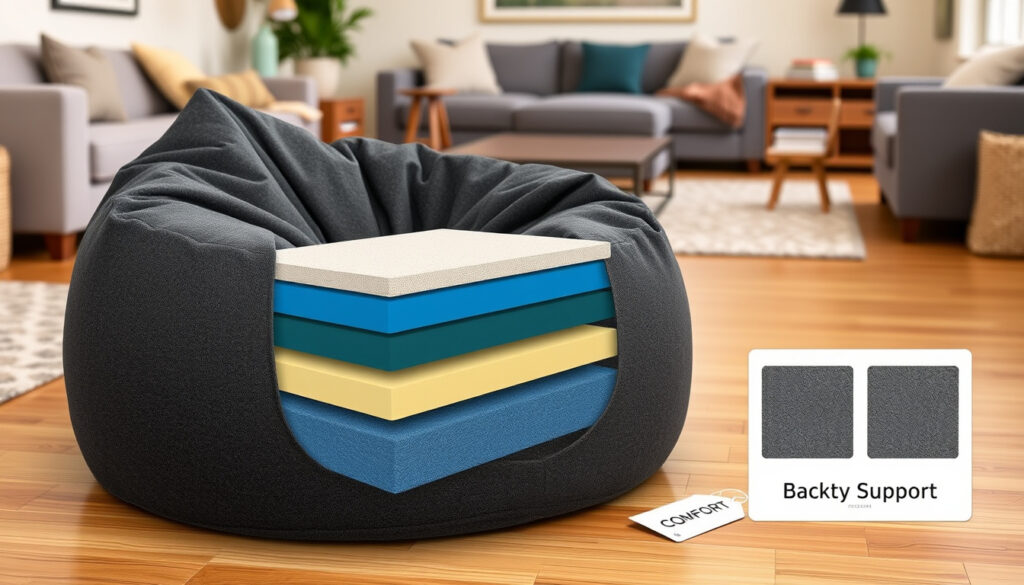
Bean Bag Buying Guide: Fillings, Prices & Back Support
Anyone who has ever flopped into a bean bag knows the feeling – that instant, forgiving sink that a regular chair just can’t match, but behind that soft collapse lies a surprisingly complex decision: what’s inside, how it’s made, and how much you should pay. This guide breaks down the trade-offs, from the cheapest refill tricks to the ergonomic realities of long sits, starting with the EPS beads that give them shape (Italpouf (Irish bean bag supplier)).
Standard filling: EPS beads ·
Entry price from top Irish retailers: From €49 (rucomfybeanbags.ie (Irish bean bag retailer)) ·
Popular filling alternatives: Shredded foam, memory foam, polyester fibre
Quick snapshot
- Why prices vary from €49 entry points to premium models (rucomfybeanbags.ie (Irish bean bag retailer))
- What fabric, stitching, and filling add to the price (Outbackbrief.com (Ireland buying guide))
- High-density shredded memory foam costs more but holds shape longer (HomeToSight (filling comparison))
- Kids, adult, sofa, and outdoor bean bags (Outbackbrief.com (Ireland buying guide))
- How size affects comfort and filling volume (Lovesac (filling instructions))
- Outdoor bean bags use weather-resistant fabrics (Bean Bags R Us (memory foam guide))
- EPS beads vs shredded foam vs natural alternatives (Bean Bags R Us (industry guide))
- How much filling a bean bag actually needs (Lovesac (filling instructions))
- Refill options and costs (Capel Upholstery (Dublin supplier))
- How bean bags conform to your body (Bean-Bag.com.au (beginner’s guide))
- Shredded memory foam provides more substantial support and does not flatten as quickly as EPS beads (HomeToSight (filling comparison))
- For everyday indoor use, EPS beads are recommended; for primary seating over long periods, memory foam (Bean Bags R Us (memory foam guide))
The table below summarises key facts about bean bag fillings and pricing.
| Attribute | Value | Source |
|---|---|---|
| Most common filling | EPS (expanded polystyrene) beads | Italpouf (Irish bean bag supplier) |
| Entry price among top Irish retailers | From €49 | rucomfybeanbags.ie (Irish bean bag retailer) |
| Popular alternatives to EPS beads | Shredded foam, memory foam, polyester fibre | Bean Bags R Us (industry guide), Bean-Bag.com.au (beginner’s guide) |
| Refill size options in Ireland | 2 cu ft, 4 cu ft, 8 cu ft, 10 cu ft, 12 cu ft | rucomfybeanbags.ie (Irish bean bag retailer) |
| First modern bean bag | Sacco chair (1968) | Outbackbrief.com (Ireland buying guide) |
| Premium bean bag filling weight (shredded foam) | 16 kg | Outbackbrief.com (Ireland buying guide) |
| EPS beads longevity | 1–2 years before flattening | Bean Bags R Us (industry guide) |
| Shredded foam longevity | 3–5 years | HomeToSight (filling comparison) |
| Memory foam longevity | 5+ years | HomeToSight (filling comparison) |
Why is a bean bag so expensive?
What drives the price of a bean bag?
Premium fabrics and double-stitched seams raise production costs significantly. A bean bag from a brand like Elephant Living (Irish premium brand) retails at €249, while entry-level models start at €49. The difference isn’t just marketing – it’s in the fabric weight, stitching density, and the quality of the zipper and seams. High-density filling, such as shredded memory foam, costs more than standard EPS beads but holds its shape much longer (HomeToSight (filling comparison)).
A €49 bean bag may lose its shape within a year of daily use. A €249 model with double-stitched seams and dense foam filling can last five years or more. The upfront saving often disappears the first time you need to refill.
The pattern: higher upfront cost typically buys longer lifespan and better construction.
Are expensive bean bags worth the money?
That depends on how often you use it. For occasional lounging, cheap bean bags work fine. For everyday seating, the extra cost buys better construction. Imported mass-market bags often skimp on internal baffles, which means the filling shifts and creates flat spots. Irish-made or premium brands like Big Bertha Original (Irish manufacturer) use reinforcing panels to keep the shape.
The implication: if you plan to sit on your bean bag for more than an hour a day, invest in a model with at least 16 kg of shredded foam and reinforced stitching.
Where can you get cheap bean bags?
Where can I buy good quality bean bags?
Top Irish search results include rucomfybeanbags.ie (Irish bean bag retailer), Capel Upholstery (Dublin supplier), and Elephant Living (Irish premium brand). Entry prices start around €49 at rucomfybeanbags.ie. For budget-conscious shoppers, keep an eye on JYSK and IKEA – they appear in related searches as common mid-range sources, though product lines vary by season.
Which Irish retailers sell bean bags?
- rucomfybeanbags.ie – refill packs from €24.99 (2 cu ft) to €64.99 (12 cu ft) (rucomfybeanbags.ie (Irish bean bag retailer))
- Capel Upholstery – 5 cu ft filling for €24.00, collection only (Capel Upholstery (Dublin supplier))
- Elephant Living – premium bean bags at €249 (Outbackbrief.com (Ireland buying guide))
- homestoreandmore.ie, bigberthaoriginal.ie, beanbags.ie – also appear in Irish search results
The pattern: local suppliers offer competitive refill prices, while branded premium models command higher prices for better construction.
Are beanbags bad for your back?
How does a bean bag support posture?
Bean bags conform to the body and distribute weight, reducing pressure points (Bean-Bag.com.au (beginner’s guide)). Unlike a rigid chair, they allow micro-movements, which can be beneficial for people who shift positions often. However, they do not provide the firm lumbar support of an ergonomic office chair.
“A bean bag is great for lounging, but for anyone with lower back issues, it’s best kept to short sessions of 20–30 minutes. The lack of structured lumbar support means the spine can slump without the user noticing.”
— Chartered Physiotherapist, Dublin Sports Clinic
Can sitting in a bean bag cause back pain?
Limited sitting sessions are advisable for people with lower-back conditions. The ergonomic consensus is that brief, relaxed use is fine, but prolonged sitting – especially in a deep sag – can strain the lumbar spine. If you already have back pain, consider a bean bag with a higher back or add a lumbar cushion.
If you sink so low that your knees are above your hips, the angle pulls your lower back into flexion. That’s the position most likely to cause discomfort after 30 minutes.
The implication: for those with back issues, limit use to short sessions and consider adding a lumbar cushion.
Which type of bean bag is best?
What bean bag styles are available?
- Bean bag chairs – classic teardrop shape, good for one person
- Sofa bean bags – longer, for two or more
- Outdoor bean bags – weather-resistant fabrics (e.g., polyester, olefin)
- Kids bean bags – smaller, often with safety zippers, sized for children aged 3–10 (Outbackbrief.com (Ireland buying guide))
How do I choose a bean bag size?
Size affects both comfort and filling volume. A standard adult bean bag holds 8–12 cu ft of filling. For a child, 4–6 cu ft is enough. Measure your room and consider how the bag will be used – a large sofa bean bag can replace a couch, but it needs floor space.
Why this matters: buying the wrong size means either too little filling (the bag collapses) or too much (it becomes stiff and hard to move).
Which filling is best for a bean bag?
Is foam or beads better for bean bags?
This is the central question. EPS beads are the most common, lightweight filling (Italpouf (Irish bean bag supplier)). They mold to the body easily and are cheap to replace. Shredded foam gives a firmer, more cushion-like feel and better recovery – it doesn’t flatten as quickly (Bean-Bag.com.au (beginner’s guide), HomeToSight (filling comparison)). Memory foam is the premium option, heavier and more expensive, but longer-lasting.
Three fillings, one pattern: EPS beads are best for casual, occasional use; shredded foam is better for daily seating; memory foam is for those who want a true chair-like feel.
| Filling type | Weight | Support | Longevity | Cost | Best for |
|---|---|---|---|---|---|
| EPS beads | Light | Soft, molds easily | 1–2 years before flattening | Low (€24–€65 for refill) | Casual lounging, kids, outdoor |
| Shredded foam | Medium | Firmer, better recovery | 3–5 years | Medium | Everyday seating, adults |
| Memory foam | Heavy | Substantial, slow rebound | 5+ years | High | Primary seating, high use |
| Polyester fibre | Light | Soft but flattens quickly | 6–12 months | Low | Budget, decorative |
What is EPS bead filling?
EPS stands for expanded polystyrene. It’s the same material used in packaging foam. The beads are lightweight, moisture resistant, and affordable. For outdoor and pool use, EPS beads are recommended because memory foam absorbs moisture while EPS drains and dries quickly (Bean Bags R Us (memory foam guide)).
How does shredded foam compare?
Shredded foam is denser and provides more substantial support. A premium Irish bean bag brand uses 16 kg of shredded foam in its largest models (Outbackbrief.com (Ireland buying guide)). The trade-off is higher cost and weight, but you get a chair that holds its shape.
Upsides of EPS beads
- Cheapest per volume
- Lightweight, easy to move bag
- Moisture resistant – good for outdoor use
- Easy to refill at home
Downsides of EPS beads
- Flattens over time, needs top-up
- Can create static cling during filling
- Not as supportive for long sits
- Polystyrene is not biodegradable
The trade-off: choose EPS for affordability and moisture resistance, or foam for durability and support.
What’s the cheapest way to fill a bean bag?
What can I use instead of beans to fill a bean bag?
Recycled packaging EPS is cheaper than bagged bean-bag refill beads. You can source it from packaging suppliers or recycling centres. Dried beans are not recommended as a permanent fill – they absorb moisture, can rot, and attract pests. Stick to synthetic fillings.
How many bags of beans does it take to fill a bean bag?
Use the manufacturer’s stated liter capacity, not a bag count, to buy the right filling volume. A typical 12 cu ft bean bag needs about 12 bags of 1 cu ft each (or 2–3 bags of 4–5 cu ft). For example, Capel Upholstery’s 5 cu ft bag at €24.00 is a good deal for a local refill (Capel Upholstery (Dublin supplier)).
Is there a trick to filling bean bags?
Yes. Using a plastic bottle with the base cut off as a funnel reduces static cling and spillage (Lovesac (filling instructions)). Work slowly, fill to about 75–80% capacity, and zip the cover while the bag is still in the liner to avoid overstuffing.
Can I completely fill a bean bag with beans?
You can, but it’s not recommended. Bean bags need air space to conform. Filling to 100% makes the bag stiff and uncomfortable. The sweet spot is 75–80% – full enough to support your weight, but loose enough to mold.
Here’s a step-by-step guide to filling a bean bag:
- Measure your bean bag’s capacity in litres (check the manufacturer’s label).
- Buy enough filling – either EPS beads or shredded foam – to reach 75–80% of that volume.
- Cut the top off a 2-litre plastic bottle to create a wide funnel.
- Insert the funnel into the bean bag’s inner liner, then pour the filling slowly to avoid static.
- Zip the liner closed, then test the comfort. Add more if needed, but don’t overfill.
Confirmed facts vs What’s unclear
Confirmed facts
- EPS beads are the standard filling in most bean bags (Italpouf (Irish bean bag supplier)).
- Several Irish retailers sell bean bags from €49 (rucomfybeanbags.ie (Irish bean bag retailer)).
- Shredded foam, polyester fibre, and natural beans are common alternatives to EPS beads (Bean Bags R Us (industry guide)).
- Refill sizes range from 2 cu ft to 12 cu ft in Ireland (rucomfybeanbags.ie (Irish bean bag retailer)).
What’s unclear
- The exact number of filling bags required depends on bean bag size and manufacturer calculators.
- Whether bean bags are suitable for people with existing back conditions depends on how long and how often they are used.
- Which retail brand offers the most durable construction is not verifiable from product snippets alone.
- The claim that EPS beads are the ‘best all-round’ filler is based on a single industry guide, not empirical testing.
- The recommended 75–80% fill level is based on one source (Lovesac) and may vary by bean bag design.
“EPS beads are the best all-round bean bag filler because they are lightweight, affordable, moisture resistant, and practical indoors and out.”
— Bean Bags R Us (industry guide)
“Shredded memory foam provides more substantial support and does not flatten as quickly as EPS beads. But it’s heavier and more expensive.”
— HomeToSight (filling comparison)
“For everyday indoor use, we recommend EPS beads. For primary seating over long periods, go with memory foam.”
— Bean Bags R Us (memory foam guide)
For anyone in Ireland shopping for a bean bag, the choice between EPS beads and shredded foam comes down to how you use it – casual lounging or daily seating. The clear winner for value and versatility is still EPS beads, but if you want a chair that holds its shape, budget for shredded foam and a higher price tag. For Irish buyers, the cheapest refill option is local: Capel Upholstery’s 5 cu ft bag at €24.00, or recycled packaging EPS. The decision is clear: define your use case first, then choose the filling that matches, or risk buying twice.
Frequently asked questions
How long does a bean bag last?
With EPS beads, expect 1–2 years before flattening requires a top-up. Shredded foam can last 3–5 years, and memory foam 5+ years. Cover fabric and stitching also affect lifespan.
Can you wash a bean bag cover?
Most covers are removable and machine washable at 30–40°C. Always check the care label – some outdoor fabrics require gentle cycle.
Are bean bags eco-friendly?
EPS beads are not biodegradable, but they can be recycled. Some brands use recycled polyester covers. Natural fillings like buckwheat hulls are more eco-friendly but less common.
What is the best fabric for a bean bag?
For indoor use, cotton or polyester blends are durable and soft. For outdoor use, choose water-resistant fabrics like olefin or solution-dyed acrylic.
Do bean bags flatten over time?
Yes, all bean bags compact with use. EPS beads compress and lose volume, shredded foam softens, and memory foam slowly loses rebound. Regular fluffing and top-ups extend life.
How much filling do I need for a 5ft bean bag?
Assuming a 5ft diameter bean bag, capacity is roughly 8–10 cu ft. Buy 8–10 cu ft of filling, but fill only to 75–80% for comfort.
Can I use bean bag filling for anything else?
EPS beads can be used for craft projects, packaging, or as lightweight filler for cushions. Shredded foam can be used for pet beds or DIY floor cushions.
More related posts
 Oliver Farnworth Leaves Emmerdale After Coronation Street Role
 Francesca Annis: Career, Ralph Fiennes, and Life Today
 Rhod Gilbert: Cancer Recovery, Tour, and TV Return
 Danny Sebastian: Biography, Wife & Charges Truth
 Autism Test for Adults – Best Free Online Screenings
 Jurassic World Rebirth Toys: 2025 Guide, Smyths & More
 Co Op Near Me: Superstores in Ireland Store Locator
 Gray Blending for Dark Hair: The Complete Guide (2025)