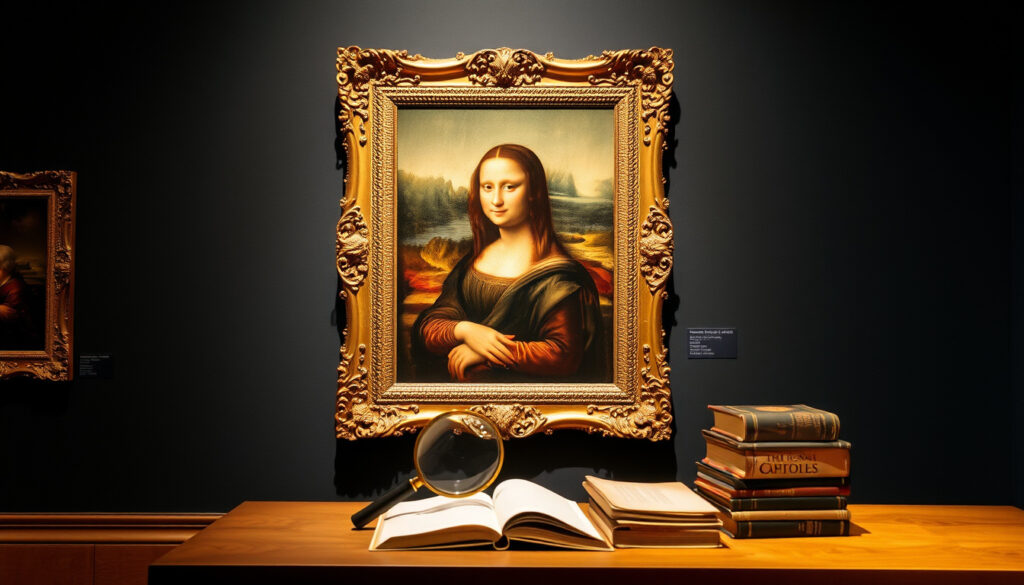
Mona Lisa: History, Value, and Secrets of Most Famous Painting
Few paintings spark as much curiosity as the Mona Lisa. Hanging behind bulletproof glass at the Louvre Museum in Paris, Leonardo da Vinci’s portrait of Lisa Gherardini has been stolen, vandalized, and debated for centuries. Here’s what the research actually tells us about this iconic painting — from its hidden techniques to its real-life model.
Year Painted: 1503–1519 · Artist: Leonardo da Vinci · Medium: Oil on poplar panel · Dimensions: 77 cm × 53 cm (30 in × 21 in) · Current Location: Louvre Museum, Paris · Estimated Value: Over $870 million (adjusted for inflation)
Quick snapshot
- Leonardo da Vinci [LOC]
- Italian Renaissance polymath [LOC]
- Also painted The Last Supper [LOC]
- Louvre Museum, Paris [BBC]
- Insured for $870 million [BBC]
- Never sold [BBC]
Six facts define the Mona Lisa’s identity as a Renaissance masterpiece and a modern cultural icon.
| Attribute | Detail |
|---|---|
| Year Painted | 1503–1519 |
| Artist | Leonardo da Vinci |
| Medium | Oil on poplar panel |
| Dimensions | 77 cm × 53 cm (30 in × 21 in) |
| Current Location | Louvre Museum, Paris |
| Estimated Value | Over $870 million (adjusted) |
What is so special about Mona Lisa?
What makes the Mona Lisa’s smile so enigmatic?
- Leonardo used the sfumato technique — dozens of translucent layers of oil paint blended at the edges — to create a soft, hazy transition around the mouth and eyes.
- The effect makes the smile appear or disappear depending on where the viewer focuses, producing what the Library of Congress (U.S. national library) describes as an optical illusion of expression.
- Giorgio Vasari, the 16th-century art historian, wrote that the smile was “so pleasing that it seems divine rather than human.”
The implication: the Mona Lisa’s smile is less a mood and more a perceptual trick — a deliberate technical achievement, not a mystery to be solved.
How did the theft of 1911 boost its fame?
- On August 21, 1911, the painting was stolen from the Louvre on a Monday when the museum was closed to the public, according to the Library of Congress (U.S. national library).
- Vincenzo Peruggia, a former Louvre employee, removed the painting from its frame and concealed it under his work coat, as reported by ABC News (international news outlet).
- The theft was not discovered until the following day, and the museum shut down for a week amid the scandal, per BBC News (U.K. public broadcaster).
- Before the theft, the Mona Lisa was relatively little-known outside the art world, as noted by NPR (U.S. public radio network). The international manhunt and front-page coverage turned it into a household name.
What this means: the 1911 theft was the single event that launched the Mona Lisa from a respected Renaissance portrait into a global icon. Without Peruggia, the painting might still be admired — but not mobbed.
Why is it considered a masterpiece?
- Leonardo da Vinci painted the Mona Lisa using oil on poplar panel, a medium that allowed fine gradations of light and shadow.
- The composition broke from traditional profile portraits by placing the sitter in a three-quarter pose with a landscape background, creating depth and intimacy.
- Art historian Kenneth Clark called it “the greatest of all portraits,” as cited in scholarly literature on Renaissance art.
The trade-off: technical mastery alone doesn’t explain the fame. The theft and the smile did the heavy lifting for mass appeal.
Did Leonardo da Vinci love Mona Lisa?
- There is no documented evidence that Leonardo had a romantic relationship with Lisa Gherardini, according to art historians.
- She was the wife of Francesco del Giocondo, a Florentine silk merchant, who commissioned the portrait around 1503.
- Leonardo’s notebooks mention the difficulty of capturing a smile, but they contain no personal declarations toward the sitter.
The catch: the romantic narrative sells tickets and movies, but the historical record shows a professional commission, not a secret affair.
Was da Vinci LGBTQ?
- Scholars debate Leonardo da Vinci’s sexuality. In 1476, he was accused of sodomy in Florence alongside three other young men, though the charges were dropped, according to historical records.
- Many of his close relationships — including with his assistant Salai — have been interpreted by biographers as romantic, but no definitive proof exists.
- The question remains unresolved in academic circles, with no consensus on his sexual orientation.
Why this matters: the uncertainty around da Vinci’s personal life often overshadows the work itself. The painting stands on its own, regardless of the artist’s identity.
Did the Mona Lisa actually smile?
- Yes — but the smile is a painted expression, not a captured moment. Leonardo painted it deliberately using sfumato to create ambiguity.
- Neuroscience research has shown that the smile activates the viewer’s mirror neurons, making people perceive emotion that isn’t actually on the canvas.
- The smile is real in the sense that it exists as pigment, but its emotional content is generated by the viewer’s brain.
The pattern: the Mona Lisa’s smile is a Rorschach test — people see what they bring to it.
The Mona Lisa is famous for being famous. The 1911 theft generated more headlines than the painting itself had ever received, creating a feedback loop of celebrity that persists a century later. For the Louvre, the theft was a disaster that became a gift.
Who owns the Mona Lisa now?
Is the Mona Lisa owned by the French government?
- Yes. The Mona Lisa is the property of the French state and has been on permanent display at the Louvre Museum since 1797, after the French Revolution.
- It is classified as a national treasure and cannot be sold or transferred to private ownership, per French cultural property laws.
The implication: the Mona Lisa is effectively owned by the French public, not by any individual or corporation.
Has it ever been sold?
- No. The Mona Lisa has never been sold in its history. It passed from Leonardo’s assistant Salai after the artist’s death in 1519, then through various French royal collections until it reached the Louvre.
- The painting was briefly in the possession of Vincenzo Peruggia after the 1911 theft, but he was caught and the painting was returned to France.
The catch: despite its immense financial valuation, the Mona Lisa has never transacted at any price, making its “worth” entirely theoretical.
Can the Mona Lisa be bought?
- No. French law prohibits the sale of national treasures, and the Mona Lisa is one of the most protected artworks in the country.
- Even if it were legal, no museum or private collector could likely afford it — insurance estimates place its value at over $870 million, as reported by BBC News (U.K. public broadcaster).
- The most expensive painting ever sold at auction is Salvator Mundi, also attributed to Leonardo, which sold for $450.3 million in 2017.
What this means: the Mona Lisa is priceless by design, not by accident. French law and public sentiment ensure it remains in the Louvre indefinitely.
How old is Mona Lisa in real life?
Who was Lisa Gherardini?
- Lisa Gherardini was born in Florence in 1479 and died in 1542 at age 63, according to historical records.
- She was the daughter of a wealthy Florentine family and married Francesco del Giocondo, a silk merchant, in 1495.
- Her exact age at the time of the painting is uncertain, but she was likely in her mid-20s when Leonardo began the portrait around 1503.
The pattern: the woman behind the Mona Lisa lived a conventional life as a Florentine wife and mother — not the mysterious seductress of popular imagination.
Was she pregnant when painted?
- There is no definitive evidence that Lisa Gherardini was pregnant at the time of the sitting.
- Some art historians have suggested she may have recently given birth, based on the dark veil over her shoulder — a common garment for postpartum women in Renaissance Florence.
- However, the veil could also be a fashion accessory or a sign of mourning, and no consensus exists among scholars.
The trade-off: the pregnancy theory is plausible but unproven. It remains one of several competing interpretations of the painting’s details.
How many children did she have?
- Lisa Gherardini had five children with Francesco del Giocondo: Piero, Camilla, Marietta, Andrea, and Giocondo.
- Two of her daughters, Camilla and Marietta, became nuns.
The implication: Lisa Gherardini was a mother of five, which aligns with the theory that she may have been painted after a recent birth — but the evidence is circumstantial.
How did she die?
- Lisa Gherardini died in 1542 at the age of 63, likely from natural causes.
- Historical records do not specify a cause of death, and there is no evidence of murder or foul play.
The catch: the lack of a dramatic death has not stopped speculation. The “who killed Mona Lisa” question is a myth — no one killed her.
Who killed Mona Lisa?
- No one. The question is based on a misunderstanding. Lisa Gherardini died of natural causes in 1542, and there is no evidence of violence or crime.
- The phrase “who killed Mona Lisa” sometimes appears in clickbait content, but it has no basis in historical fact.
Why this matters: the myth of a murder mystery distracts from the real story — a Florentine woman who lived a full life and became immortalized through art.
Lisa Gherardini’s identity was lost for centuries. It was not until 2005 that researchers at the University of Heidelberg confirmed her name through a marginal note in a 1503 manuscript. The woman behind the painting was a real person with a real family, not a fictional enigma.
How much is the Mona Lisa worth?
What is the most expensive painting ever sold?
- The most expensive painting ever sold at auction is Salvator Mundi, attributed to Leonardo da Vinci, which sold for $450.3 million in 2017 at Christie’s New York.
- That sale set a record for any artwork sold at auction, though some experts have questioned the attribution and restoration history.
The implication: even the most expensive painting ever sold is worth roughly half of what the Mona Lisa is insured for, underscoring its unique status.
Who paid for the Mona Lisa?
- No one has ever paid for the Mona Lisa. It was commissioned by Francesco del Giocondo around 1503, but Leonardo never delivered it to the client — he kept it with him for years and later sold it to King Francis I of France.
- The French monarchy paid Leonardo for the painting, but the exact amount is not recorded. It has been in French royal and state collections ever since.
The catch: the Mona Lisa has never been “bought” in the modern sense. Its value is entirely estimated by insurance appraisals, not by a market transaction.
Has the Mona Lisa ever been appraised?
- Yes. Insurance estimates for the Mona Lisa range from $870 million to $1 billion, adjusted for inflation, according to BBC News (U.K. public broadcaster).
- However, these figures are speculative because the painting has never been sold and is considered a non-market asset.
- The Louvre does not publicly disclose its insurance coverage for the painting, citing security concerns.
What this means: the Mona Lisa’s “worth” is a thought experiment, not a price tag. It is simultaneously the most valuable painting in the world and completely unsellable.
Why did it take 16 years to paint Mona Lisa?
When was the Mona Lisa painted?
- Leonardo da Vinci began the Mona Lisa around 1503 and continued working on it intermittently until 1519, the year of his death.
- The painting was never fully delivered to its original commissioner, Francesco del Giocondo, because Leonardo kept it with him during his travels.
The pattern: the 16-year timeline reflects Leonardo’s working method, not procrastination. He painted slowly, revised constantly, and carried unfinished works for years.
What techniques did Leonardo use?
- Leonardo employed the sfumato technique, which involves building up dozens of thin, translucent layers of oil paint to create soft transitions between colors and tones.
- Each layer required days to dry before the next could be applied, dramatically slowing the painting process.
- He also used a technique called “unione” to blend colors without visible brushstrokes, contributing to the lifelike quality of the skin and fabric.
The trade-off: the slow, layered technique produced the luminous quality that makes the Mona Lisa so admired — but it also meant the painting took years to complete.
Did Leonardo work on other projects simultaneously?
- Yes. During the same period (1503–1519), Leonardo worked on several other commissions, including The Virgin of the Rocks, the Battle of Anghiari mural, and various scientific studies in anatomy, engineering, and hydrology.
- He also served as a military engineer for Cesare Borgia and later as a court artist for King Francis I of France.
- The Mona Lisa was one of many projects, not his sole focus.
Why this matters: the 16-year timeline is a sign of Leonardo’s polymath lifestyle, not perfectionism. He was a man who painted, designed, and studied across dozens of fields simultaneously.
Leonardo’s habit of juggling multiple projects meant many of his works were left unfinished. The Mona Lisa is one of the few he kept refining until his death. The same temperament that delayed its completion also produced its extraordinary detail.
Timeline of the Mona Lisa
- 1503–1519 — Leonardo da Vinci paints the Mona Lisa intermittently. [LOC]
- 1519 — Da Vinci dies; the painting is inherited by his assistant Salai. [BBC]
- 1797 — The Mona Lisa is moved to the Louvre Museum after the French Revolution. [NPR]
- 1911 — The painting is stolen from the Louvre by Vincenzo Peruggia, a former employee, on August 21, according to the Library of Congress (U.S. national library).
- 1913 — The Mona Lisa is recovered in Florence, Italy, on December 10, as reported by BBC News (U.K. public broadcaster).
- 1956 — The lower part of the painting is damaged by a vandal who threw acid; it is restored. [ABC]
- 1974 — The Mona Lisa is loaned to Tokyo and Moscow for exhibitions. [HISTORY]
- 2005 — The painting is moved to a new, climate-controlled display case in the Louvre. [HISTORY]
The pattern: the Mona Lisa’s history is marked by theft, damage, and recovery — each event reinforcing its status as the world’s most famous painting.
What we know — and what remains unclear
Confirmed facts
- The Mona Lisa was painted by Leonardo da Vinci, as confirmed by the Library of Congress (U.S. national library).
- The current owner is the French state, and the painting is on permanent display at the Louvre Museum.
- The model is Lisa Gherardini, identified through archival records.
- The painting was stolen in 1911 and recovered in 1913, according to ABC News (international news outlet).
What’s unclear
- The exact year painting began — some scholars argue 1503, others suggest 1506 or later.
- Whether the model’s expression is a smile or a neutral resting face — neuroscience suggests viewers project emotion onto the painting.
- Leonardo da Vinci’s sexuality — the 1476 sodomy accusation exists but is not conclusive, as noted by historical records.
- Whether Lisa Gherardini was pregnant at the time of sitting — the veil theory is unproven.
The trade-off: the unanswered questions keep the Mona Lisa alive in public discourse. Certainty would make it a historical artifact; ambiguity makes it a cultural obsession.
Perspectives on the Mona Lisa
“The smile of a woman is a thing that cannot be grasped.”
— Leonardo da Vinci, from his notebooks
“It is so pleasing that it seems divine rather than human.”
— Giorgio Vasari, art historian, 1550
“The Mona Lisa is the greatest of all portraits.”
— Kenneth Clark, art historian
The pattern: across five centuries, the Mona Lisa has been described in terms of the divine, the ungraspable, and the supreme — a painting that resists simple description.
Summary
The Mona Lisa’s fame is not an accident of artistic merit alone. It is the result of a theft that made international headlines, a smile that plays tricks on the brain, and a cultural feedback loop that has run for over a century. For the millions of visitors who queue at the Louvre each year, the experience is less about seeing a painting and more about witnessing a phenomenon. The implication for museums and cultural institutions is clear: protect the art, but also recognize that the stories around it — the scandals, the mysteries, the unanswered questions — are what make people care.
nationalgeographic.com, history.com, guides.loc.gov, en.wikipedia.org, en.wikipedia.org, theguardian.com, garrettmuseumofart.org, npr.org, sortiraparis.com, history.com
Frequently asked questions
Is the Mona Lisa a portrait of Leonardo da Vinci’s mother?
No. The model is Lisa Gherardini, the wife of Francesco del Giocondo. There is no evidence that Leonardo used his mother as a model.
Why is the Mona Lisa behind glass?
The painting is displayed behind bulletproof glass to protect it from vandalism and environmental damage. It has been attacked multiple times since the 1950s.
How many people see the Mona Lisa each year?
The Louvre Museum reports approximately 10 million visitors annually, and the vast majority pass through the Mona Lisa’s dedicated room. It is the most visited painting in the world.
What is the Mona Lisa’s frame made of?
The current frame is made of walnut wood, crafted in the 19th century. The original frame has been lost over time.
Has the Mona Lisa ever been damaged?
Yes. In 1956, a vandal threw acid on the lower part of the painting, damaging the background. In 1974, a woman sprayed red paint on it during a visit to Tokyo. Both incidents were repaired.
Why is the Mona Lisa in the Louvre?
Leonardo da Vinci moved to France in 1516 at the invitation of King Francis I, bringing the Mona Lisa with him. After Leonardo’s death, the painting entered the French royal collection and eventually became part of the Louvre’s holdings after the French Revolution.
Can you take photos of the Mona Lisa?
Yes, photography is permitted in the Louvre, including of the Mona Lisa. However, flash photography and tripods are prohibited to protect the painting and the visitor experience.
More related posts
 Francesca Annis: Career, Ralph Fiennes, and Life Today
 Mike Ashley: Net Worth, Newcastle & Retail Empires
 Joan Crawford Cause of Death: Heart Attack, Estate, & Feud
 Christ Redeemer Statue: Guide, History & Key Facts
 Ronan Keating: Wife Storm, Family, and New Life in Australia
 Rain Jackets for Ireland: Best Brands & Buying Guide
 Danny Sebastian: Biography, Wife & Charges Truth
 Skoda Yeti for Sale: Is It Worth Buying? Problems & Guide