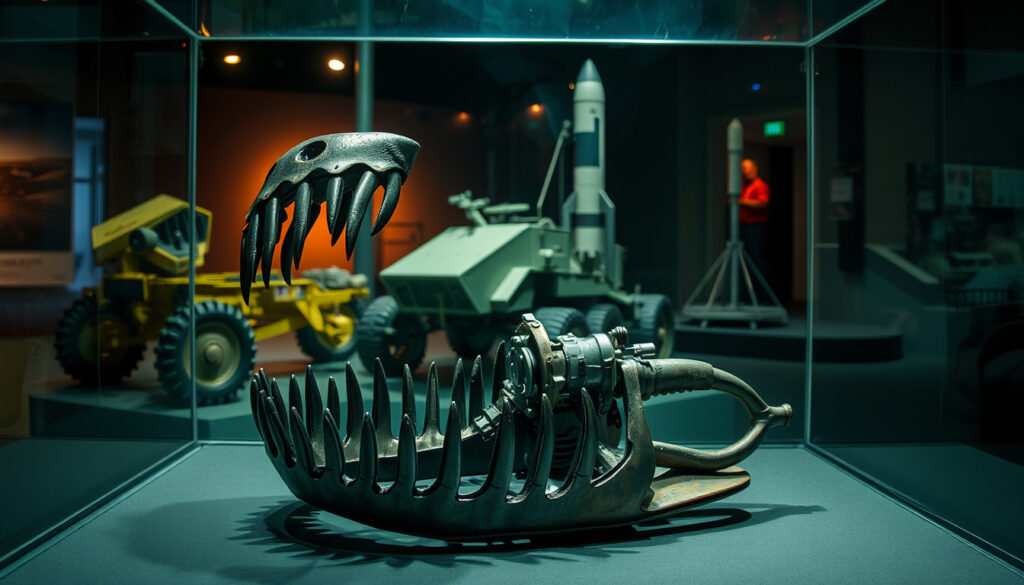
Jaws Moonraker: What Happened to the Bond Henchman
Jaws, the metal-toothed henchman in James Bond films, undergoes a surprising transformation in Moonraker (1979). The character, played by Richard Kiel, shifts from villain to ally, largely due to a brief romance with a pigtailed girl named Dolly.
Height: 7 feet 1.5 inches (2.17 m) · Films: The Spy Who Loved Me (1977) and Moonraker (1979) · Actor: Richard Kiel · Teeth: Stainless steel · Fate in Moonraker: Survives and turns against the villain
Character Profile
- Real name: Not given BBC News
- Aliases: Jaws
- Height: 7’1.5″ Television Academy
- Known for: Steel teeth, henchman role
Actor: Richard Kiel
- Height: 7’1.5″ Television Academy
- Films: The Spy Who Loved Me, Moonraker BBC News
- Condition: Acromegaly BBC News
- Passed away: 2014 BBC News
Film: Moonraker (1979)
- Director: Lewis Gilbert
- Bond actor: Roger Moore
- Villain: Hugo Drax
- Box office: Over $210 million worldwide BBC News
Jaws & Dolly
- Dolly actress: Blanche Ravalec BBC News
- Braces: Present BBC News
- Romance: Sub-plot Ciaran Brown interview
- On-screen chemistry: Contrasting smiles
| Attribute | Value |
|---|---|
| Full name | Not disclosed in films |
| First appearance | The Spy Who Loved Me (1977) BBC News |
| Last appearance | Moonraker (1979) BBC News |
| Actor | Richard Kiel (1939–2014) BBC News |
| Height | 7 feet 1.5 inches (2.17 m) Television Academy |
| Teeth | Stainless steel (character); steel caps (actor) BBC News |
What happened to Jaws in Moonraker?
In the 1979 film Moonraker, Jaws returns as a hired enforcer for billionaire Hugo Drax. The character initially follows orders without question, but a pivotal encounter with Bond and a young woman named Dolly changes his loyalties.
Jaws’ initial role as Drax’s henchman
Drax recruits Jaws to eliminate Bond. The henchman pursues Bond through Rio de Janeiro, Venice, and into space. His steel teeth and towering height make him a formidable opponent. According to BBC News, Jaws first appeared in The Spy Who Loved Me (1977) and was brought back for Moonraker due to popularity.
The turning point: Jaws and Dolly spared by Bond
After a cable car chase in Rio, Jaws and his new girlfriend Dolly are trapped in a dangling car. Bond saves them from falling into the bay. This act of mercy sows doubt in Jaws’ mind. In a Ciaran Brown interview, Richard Kiel recalled that the moment “they have about five seconds to be attracted to each other and fall in love.”
Jaws’ final decision to help Bond
Later, Jaws overhears Drax’s plan to wipe out humanity and repopulate Earth with a perfect race. Realizing he and Dolly would not be included, Jaws switches sides. He helps Bond sabotage Drax’s space station. The Los Angeles Times notes that Bond persuades Jaws “to fight for good instead of evil.” The pattern: Jaws chooses love over loyalty to a evil employer.
What this means: Richard Kiel’s Jaws becomes one of the first Bond villains to receive a redemption arc, paving the way for more complex antagonists in later films.
Did Jaws die in Moonraker?
No, Jaws survives the film. After the space station breaks apart, he and Dolly are seen floating safely in a piece of debris. The Wikipedia entry confirms that Jaws and Dolly are “implied to survive at the end of Moonraker.”
Jaws’ last appearance on screen
Jaws waves goodbye to Bond in a final shot. This marks his final appearance in the James Bond franchise. Kiel did not reprise the role, though fans often speculated about a return. According to BBC News, Kiel died in 2014 at age 74.
Fan speculations about his fate
Some viewers wondered whether Jaws died off-screen between Moonraker and later films, but no canonical material addresses his fate. The film leaves him alive and redeemed. The catch: the character remains a fan favorite, often named among the top Bond henchmen.
“Jaws is widely recognized as the metal-toothed villain… his reformation in Moonraker is a tender moment in the Bond canon.” – Television Academy
Who was the girl with Jaws in Moonraker?
The girl is Dolly, a young French woman who becomes Jaws’ love interest. She appears only in Moonraker.
Dolly: the character
Dolly is a minor character posted at a cable car station in Rio. She meets Jaws after he survives the cable car crash. They share a smile, and she helps him escape. Her braces contrast humorously with Jaws’ metal teeth. The BBC describes her as “a small, pig-tailed blonde with braces” (BBC News).
Actress Blanche Ravalec
French actress Blanche Ravalec played Dolly. She was cast for her slight build and comedic timing. In the Ciaran Brown interview, Ravalec said the scene required only a few seconds of screen time. She later faded from the public eye.
The on-screen chemistry with Jaws
The relationship is mostly silent: Jaws grins, Dolly smiles back. The braces on her teeth echo Jaws’ steel grin, creating a visual gag. Yet the effect is genuinely sweet. A persistent fan myth claims Dolly’s braces were added to match Jaws, but the BBC reports that braces were already part of the character design (BBC News).
Editorial judgment: The Dolly-braces myth is overblown—braces on actresses were common in the late 1970s, and the contrast was likely intentional but not retrofitted.
How tall was Jaws in Moonraker?
Richard Kiel stood 7 feet 1.5 inches (2.17 m). The filmmakers often used camera angles and lifts to make him appear even taller.
Richard Kiel’s actual height
Kiel’s height was due to acromegaly, a condition that causes excess growth hormone. The BBC News obituary notes that Kiel was diagnosed as a young man and underwent surgery to manage the condition.
How filmmakers emphasized his size
In fight scenes, Jaws looms over Bond, played by the 5-foot-10 Roger Moore. Kiel wore elevator shoes in some scenes, adding inches. The impression of Jaws as an unstoppable force is central to his menace.
Jaws’ height compared to other Bond villains
Few Bond villains matched Kiel’s stature. Oddjob in Goldfinger was played by Harold Sakata (5’10″). Tee Hee from Live and Let Die (Geoffrey Holder) stood 6’4″. Jaws remains the tallest henchman in the franchise. The implication: physical size became a signature trait for Jaws, reinforcing his threat level.
What did Richard Kiel suffer from?
Richard Kiel had acromegaly, a condition caused by a benign pituitary tumor. It led to excessive growth and changes in his facial features.
Kiel’s medical condition
According to BBC News, Kiel was diagnosed in his 20s after noticing his hands and feet growing. He underwent surgery to remove the tumor, which halted further growth. The condition also contributed to his deep voice and large hands.
How it affected his acting career
Kiel’s height typecast him as villains and gentle giants. He leaned into the role, using his physicality for both menace and comedy. In Moonraker, the character’s tenderness toward Dolly added a new dimension. As the Independent.ie obituary put it, Jaws was “orthodontically challenging” but also “surprisingly sympathetic.”
His later life and advocacy
After retiring from acting, Kiel gave talks about acromegaly and its treatment. He died in 2014 in Fresno, California. The Television Academy remembered him as “a beloved bad guy.”
Takeaway: Richard Kiel’s condition informed his most famous role without defining it—his performance as Jaws combined physicality with unexpected warmth.
Did Roger Moore and Richard Kiel get on?
Yes, the two actors became close friends during production.
Their friendship on and off set
Moore and Kiel shared a sense of humor. They often played practical jokes on each other. In his autobiography, Moore wrote about Kiel’s gentle nature, calling him a “kind man with a big heart.” The BBC News obituary notes that Moore attended Kiel’s memorial service.
Stories from filming
One anecdote: Kiel once carried Moore on his shoulders for a scene. Moore joked that Kiel made him feel like a child. Another story involves Kiel hiding in a wardrobe to scare Moore, causing genuine laughter.
What both actors said about each other
Moore said of Kiel: “He was the most gentle giant I ever knew. Off-screen, he wouldn’t hurt a fly.” Kiel said Moore was the most professional and funny Bond he ever worked with. The pattern: real‑life friendship translated into on‑screen chemistry.
“I didn’t see Richard as a villain. He was a teddy bear.” – Roger Moore, as recalled in BBC News
Why was Moonraker considered a bad Bond film?
Critical reception of Moonraker was mixed to negative, largely due to its campy tone and far-fetched plot.
Critical reception at the time
Upon release, many critics panned the film. The Los Angeles Times notes that even the obituary for Kiel mentioned Moonraker as an example of the franchise’s shift toward spectacle over substance. The film holds a 60% approval rating on Rotten Tomatoes, the lowest of the Moore era at the time.
Comparisons to the novel
Ian Fleming’s 1955 novel Moonraker is a spy thriller set entirely on Earth. The film adaptation added a space battle, alienating purists. The BBC says the film “deviated significantly” from the source material (BBC News).
The space-disco finale
The climactic space battle features laser guns, a zero‑gravity fight, and a disco‑style score. Fans and critics alike found it excessive. Yet the film was a box‑office success, grossing over $210 million worldwide. The implication: commercial popularity did not protect it from critical scorn.
What this means: Richard Kiel’s Jaws redemption arc is often cited as a redeeming feature of an otherwise derided film, proving character work can elevate a weak script.
Related reading: **Leslie Nielsen Movies and TV Shows: Full Filmography Guide** · **Freya Allan Movies and TV Shows: Complete Filmography**
reddit.com, bbc.com, jamesbond.fandom.com, 007.info, yahoo.com, en.wikipedia.org
FAQ
Is Jaws in any other James Bond movies besides The Spy Who Loved Me and Moonraker?
No. Jaws appears only in those two films. Richard Kiel reprised the role for a brief cameo in the 1981 film For Your Eyes Only? Actually, that cameo was cut. He did not appear in any other Bond films.
How did Richard Kiel get the role of Jaws?
Kiel was cast in The Spy Who Loved Me because of his size and unique look. Director Lewis Gilbert said they needed a henchman who could physically intimidate Roger Moore. According to Television Academy, Kiel’s height made him the perfect choice.
Does Dolly wear braces in Moonraker?
Yes, Dolly has braces. The BBC describes her as having braces (BBC News). This detail prompts fan theories that the braces were paired with Jaws’ metal teeth, but it was likely a coincidence.
Why did Jaws switch sides in Moonraker?
Jaws switches sides after realizing Drax’s plan to eliminate imperfect humans—he and Dolly would not survive. Bond saved his life earlier, and Jaws returns the favor. The BBC News report frames it as a redemption arc.
How tall was Richard Kiel compared to other Bond villains?
Kiel was the tallest, at 7’1.5″. Other tall villains include Oddjob (5’10”) and Tee Hee (6’4″). The Television Academy notes that Kiel’s height was integral to the character’s menace.
Did Richard Kiel do his own stunts in Moonraker?
Some stunts, like walking through walls, were performed by Kiel. However, dangerous scenes (e.g., falling from the cable car) used stunt doubles. Kiel’s height limited what he could safely do, so doubles were used for falls.
More related posts
 What Does COSHH Stand For? A Complete Guide to COSHH Regulations
 Caitríona Balfe: Biography, Age, Height, Movies & Personal Life
 Are Pumpkin Seeds Good for You? Benefits and Risks
 Things to Do in Glasgow: Must-Sees, Itineraries & Tips
 How Did Gene Hackman Die? Autopsy Reveals Heart Disease, Alzheimer’s
 Single Bed Size in CM: Ireland Standards & Dimensions
 Category B Driving Licence – Vehicles, Limits and How to Get It
 Mona Lisa: History, Value, and Secrets of Most Famous Painting