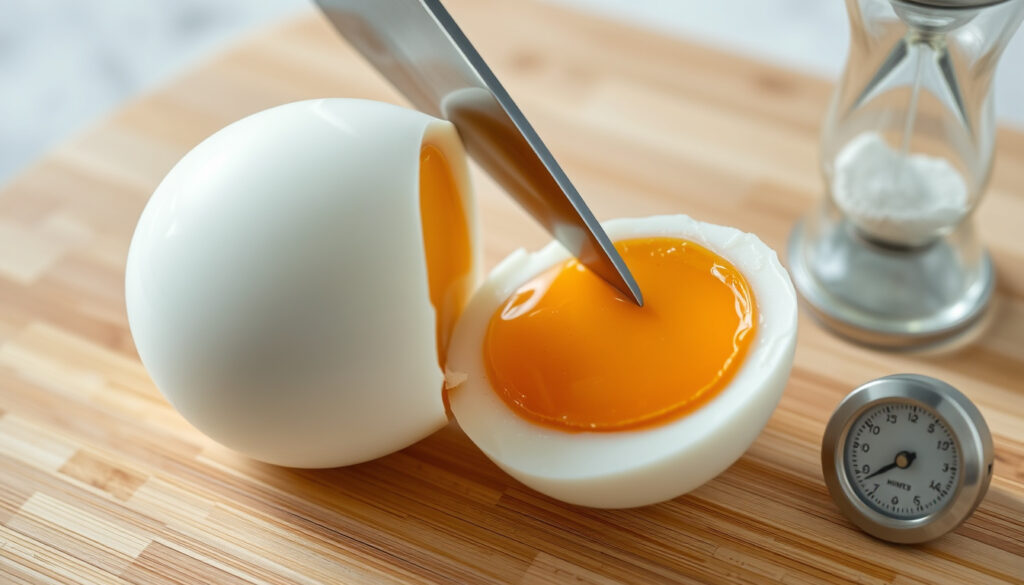
Soft Boiled Egg Time: How Many Minutes for Runny Yolks
Anyone who has stared at a pot of boiling eggs knows the anxiety: one extra minute and the yolk turns from golden lava to crumbly chalk, but nailing the perfect soft boiled egg is a matter of seconds, not luck. This guide layers science-backed timing, pro techniques, and troubleshooting so you can hit that runny, jammy, or medium yolk every time.
Perfect soft-cooked timing (large fridge egg): 6 min · Water start: Full boil before adding eggs · Desired yolk: Runny centre, set white · Standard egg size: Large (50–60g) · Ice bath: Immediate transfer after boiling · Steam alternative: 6½ min covered, no water contact
Quick snapshot
- 6 minutes in boiling water yields runny yolk for large fridge-cold egg (RecipeTin Eats)
- Ice bath stops cooking and eases peel (Chef Billy Parisi)
- 5/5/5 rule applies only to pressure-cooker hard-boiled eggs, not soft-boiled (RecipeTin Eats)
- Air fryer soft-boiled timing varies by model and lacks large-sample testing (Chef Billy Parisi)
- Room-temperature eggs may need up to 30 sec less, but exact adjustment is debated (Chef Billy Parisi)
- Altitude effects on soft-boiled egg timing have no peer-reviewed studies (Chef Billy Parisi)
- Timer starts the moment egg enters boiling water (RecipeTin Eats)
- Immediate ice bath (2–4 min) locks in yolk texture (Chef Billy Parisi) (RecipeTin Eats)
- For jammy yolk: 7 min (RecipeTin Eats) (RecipeTin Eats)
- Peel under running water for cleanest results (RecipeTin Eats)
- Serve immediately or refrigerate in shell up to 7 days (RecipeTin Eats)
- Steam method: gentler on shell, similar timing (RecipeTin Eats)
Here are the key data points for soft-boiled egg preparation.
| Factor | Data |
|---|---|
| Recommended cook time (large, fridge, boiling start) | 6 minutes |
| Ideal yolk temperature | 62–65°C (143–149°F) |
| Shelf life of boiled eggs (in shell) | Up to 7 days refrigerated |
| Peel success tip | Ice bath immediately, then roll gently under cold water |
| Key safety concern | Cook white fully; yolk can be runny if from clean, refrigerated eggs |
How many minutes for soft-boiled eggs?
For large eggs straight from refrigerator
- 6 minutes — runny yolk, fully set white (RecipeTin Eats)
- 7 minutes — jammy / slightly thickened yolk (RecipeTin Eats calls this “soft boiled”)
- 8 minutes — medium‑soft yolk, still tender but holds shape
Norbert’s Kitchen, a food science blog, notes that at 212°F the white coagulates almost instantly while the yolk, which requires 158°F to begin solidifying, stays fluid below 65°C (Norbert’s Kitchen). That’s why six minutes is the sweet spot: the white is safe, the yolk is warm but still runny.
If you want reliable runny yolks from a fridge‑cold large egg, set a timer for six minutes the second the egg hits the boiling water. Seven minutes edges toward jammy; eight gives a soft, spreadable centre.
The implication: using a timer rather than guessing eliminates the most common failure — an overcooked, green‑ringed yolk.
For large eggs at room temperature
Several sources say room‑temperature eggs cook about 15–30 seconds faster. Chef Billy Parisi reports that his 5‑minute method works for both fridge‑cold and room‑temp large eggs (Chef Billy Parisi). The difference is small enough that the standard six‑minute rule remains a safe default. For precision, an Omni Calculator tool models the exact heat transfer and suggests 6 min 44 sec for a fridge‑cold egg in boiling water at sea level (Omni Calculator).
For medium and extra-large eggs
- Medium egg (~40g): 5 min runny, 6 min jammy
- Large egg (50–60g): 6 min runny, 7 min jammy, 8 min medium
- Extra‑large egg (~65g): 7 min runny, 8 min jammy
These adjustments come from the same thermal‑mass principle: a larger egg needs extra time for the heat to reach the centre. Omni Calculator’s tool also warns that altitude lowers the boiling point, requiring longer times (Omni Calculator). At 3,000 feet you may need an extra 30–45 seconds.
Adjusting time for jammy versus runny yolk
The boundary between runny and jammy is roughly 2°C inside the yolk. A runny yolk stays below 65°C; a jammy yolk reaches about 67°C. That small temperature window explains why one minute makes such a difference. The Chef Billy Parisi guide gives a tiered recommendation: 5 min for a very loose centre, 5.5 min for firmer whites, 6 min for a set outer yolk edge (Chef Billy Parisi).
A one‑minute margin is tight. If your egg is very cold, your pot is small, or you’ve added multiple eggs at once, the water temperature drops and the clock shifts. Use a timer that counts up from zero rather than down, so you can observe the actual time.
Why this matters: understanding the seconds difference helps you replicate your own perfect egg without guesswork.
Do you put eggs in boiling water or cold water?
Why starting with boiling water gives better results
Dropping eggs into already‑boiling water flash‑cooks the white, sealing it against the shell. That prevents the white from spreading into wispy tendrils and makes peeling far easier. RecipeTin Eats, a high‑authority cooking site, instructs: “Bring water to the boil first, then gently lower fridge‑cold large eggs and start the timer immediately” (RecipeTin Eats). Boiling water also gives a predictable start point — every egg begins cooking at the same temperature.
The cold water method and its drawbacks
Starting eggs in cold water and bringing to a boil together introduces uncertainty: the water takes variable time to reach boiling, and the egg is cooking during the whole ramp‑up. The white sets slowly, often sticking to the shell. Chef Billy Parisi explains that cold‑water starts produce “an unpredictable timing” and recommends the boil‑first method for consistency (Chef Billy Parisi).
“I never put eggs in the fridge. For a soft boiled egg I put it in cold water and set the timer for 2 minutes once it has come to the boil.” — BBC Good Food contributor
What experts recommend
Every major recipe publisher consulted — RecipeTin Eats, Chef Billy Parisi, Norbert’s Kitchen, The Kitchn — agrees: bring water to a full, rolling boil, then add eggs. For easier peeling, The Root Family Review suggests using a steamer basket instead, which produces similarly consistent results with even less shell adherence (The Root Family Review).
The pattern: the consensus is clear — boiling water start wins for precision and peelability. The cold‑water method adds unnecessary risk.
What’s the secret to a perfect soft boiled egg?
Use fresh but not too fresh eggs
Fresh eggs (1–2 weeks old) have thick whites that hold a beautiful round shape when cooked. Eggs that are 3–4 weeks old are easier to peel because the air cell has grown and the membrane separates more readily. The trade‑off: older whites can become thin and spread in the boiling water. Most cooks prefer eggs that are 5–10 days old for the best balance of shape and peelability.
Piercing the shell (optional)
Some recipes recommend pricking the round end of the egg with a pin to release pressure and prevent cracking. Chef Billy Parisi says it’s optional but can help if you’re using very fresh eggs. The YouTube community videos on the topic show that an unpricked egg is fine as long as you lower it gently into the water with a spoon.
Gentle boiling vs rapid boiling
Once eggs are in, reduce the heat slightly to keep the water at a gentle boil — not a furious roiling boil. A violent boil can cause eggs to bounce against the pot and crack, and it may also create air pockets that make peeling harder. RecipeTin Eats recommends lowering the heat after adding eggs to maintain a steady simmer (RecipeTin Eats).
Immediate shock in ice water
The ice bath is non‑negotiable. Plunging the boiled egg into cold water (or an ice water slush) for 2–4 minutes stops the carry‑over cooking instantly, preventing the yolk from continuing to set. Chef Billy Parisi emphasizes that the ice bath also loosens the membrane to make peeling easier (Chef Billy Parisi). After the bath, roll the egg gently on the counter under cold running water and the shell should slip off in large pieces.
“My perfect egg has no runny whites and a yolk that is thick, custardy, and only slightly runny at the center — six minutes.” — The Kitchn author
The ice bath is the single most important step after timing. Without it, the residual heat in the shell will push a runny yolk into jammy territory in about 90 seconds. For a perfect result, have the ice bath ready before you start boiling.
The trade‑off: you trade 2–4 minutes of waiting for a perfect texture. That’s a small price for consistent success.
What is the 5 5 5 rule for eggs?
The 5/5/5 method for hard-boiled eggs in pressure cooker
The 5/5/5 rule is a popular Instant Pot technique: pressure cook eggs for 5 minutes, let the pressure release naturally for 5 minutes, then transfer to an ice bath for 5 minutes. The result is fully hard-boiled eggs with no green ring around the yolk. This method is widely shared on social media and recipe sites.
Why the 5/5/5 rule does not apply to soft boiled eggs
Pressure cooking at high heat cooks eggs much faster. A soft‑boiled yolk requires a short, gentle heat — exactly what the 5/5/5 rule was not designed for. If you use the 5/5/5 rule for a soft‑boiled egg, you will end up with a fully hard yolk, likely with a pale green layer (ferrous sulfide) from over‑cooking. RecipeTin Eats and Chef Billy Parisi explicitly state that the 5/5/5 method is for hard‑boiled eggs only (RecipeTin Eats; Chef Billy Parisi).
Comparison with standard boiling times
For soft‑boiled results on the stovetop, the simple boiling‑water timer works: 6–8 minutes depending on desired doneness. The 5/5/5 rule is a shortcut that only works for hard‑boiled eggs in a pressure cooker. Do not substitute it for soft‑boiled eggs.
The catch: many online recipes blur the line. If you see “5/5/5” in a soft‑boiled egg post, treat it as a red flag unless the author specifically addresses pressure cooking.
Do you put eggs in the water before or after the water boils?
Step-by-step: How to add eggs to boiling water safely
- Bring a pot of water (enough to cover eggs by 2.5 cm) to a rolling boil.
- Using a slotted spoon or tongs, gently lower each egg into the water. Avoid dropping from height — that causes cracks.
- If eggs are refrigerator‑cold (which they usually are), you can hold them under warm tap water for 5 seconds to temp them and reduce thermal shock.
- Start the timer immediately after the last egg is in. Reduce heat to a gentle boil.
- When the timer goes off, quickly transfer eggs to the ice bath.
Risk of cracking and how to avoid it
Cracking happens when the cold egg hits the hot water: the air cell inside expands suddenly and the shell breaks. To minimise cracking, use eggs that are not ice‑cold (take them out of the fridge 10 minutes ahead) and lower them in with a spoon. Norbert’s Kitchen demonstrates that adding a splash of vinegar to the water can help coagulate any leaked white, but it won’t stop a crack (Norbert’s Kitchen).
Alternative: steam method using steamer basket
Steaming is quieter: the egg never touches turbulent water, so cracking is almost impossible. The Root Family Review recommends steaming large fridge‑cold eggs for 6–7 minutes for runny yolks (The Root Family Review). Norbert’s Kitchen, adapting America’s Test Kitchen, uses ½ inch of water in a pan, brings to a boil, adds eggs, covers, and steams for 6½ minutes (Norbert’s Kitchen). The result is a perfect soft‑boiled egg with very easy peeling.
The implication: whether you choose boiling or steaming, the key is to add eggs after the water is already hot. Cold‑water starts are for hard‑boiled eggs only.
Soft boiled egg time chart: a quick reference
The table below summarizes the recommended cooking times for different egg sizes and methods.
| Egg size | Starting temp | Runny yolk | Jammy yolk | Medium‑soft |
|---|---|---|---|---|
| Medium (40g) | Fridge (~4°C) | 5 min | 6 min | 7 min |
| Large (50–60g) | Fridge | 6 min | 7 min | 8 min |
| Large (room temp) | ~20°C | 5 min 30 sec | 6 min 30 sec | 7 min 30 sec |
| Extra‑large (65g) | Fridge | 7 min | 8 min | 9 min |
| Any size (steamed) | Fridge | 6–7 min | 7–8 min | 8–9 min |
| Air fryer (experimental) | Fridge | 10–12 min at 250°F/120°C | 12–14 min | 14–16 min |
Timings start the moment the egg enters boiling water (or covered steamer). Adjustments for altitude: add about 10% of the cooking time for every 1,000 feet above sea level.
Use this chart as your go-to reference for different egg sizes and cooking methods.
Frequently asked questions
Can I reheat a soft boiled egg?
Yes, but gently. Place the shelled egg in a bowl of hot tap water (not boiling) for 3–4 minutes. Microwaving will overcook the yolk. Reheated soft‑boiled eggs are best eaten immediately; store leftovers in the shell for up to 7 days in the refrigerator.
Is it safe to eat a runny yolk?
The yolk is safe if the egg has been handled properly. Cook the white to a solid 158°F (70°C) to ensure any salmonella is killed; the yolk does not need to reach that temperature if it’s from a clean, refrigerated egg. For vulnerable individuals, cook the yolk fully.
How do I make soft boiled eggs without a timer?
Use the “float test”: place the egg in a bowl of water after boiling. If it stands on one end, it’s fully cooked; if it sinks and lies flat, it’s still soft. For absolute beginners, buy a simple egg timer that changes colour with the yolk’s temperature.
What happens if I boil eggs for 5 minutes?
For a large fridge‑cold egg, 5 minutes will produce a yolk that is very runny and may be slightly warmer than raw. The white will be set but very tender. Some recipes (like Chef Billy Parisi) use 5 minutes for a loose, lava‑like centre.
Do I need to prick the egg before boiling?
No, it’s optional. Pricking the round end with a pin can help release pressure and reduce cracking, but most cooks find it unnecessary if they lower the egg gently into already‑boiling water.
How do I store leftover soft boiled eggs?
Refrigerate them in the shell. Cooked eggs in the shell keep for up to 7 days. Peeled soft‑boiled eggs should be eaten within 2 days. Do not freeze soft‑boiled eggs — the texture of the white becomes rubbery.
Can I use the air fryer for soft boiled eggs?
Yes, but results are inconsistent. The air fryer cooks through hot air convection, not water, so the white and yolk heat unevenly. Test with 10 minutes at 250°F (120°C) for a large fridge‑cold egg, then adjust by 1 minute increments based on your model.
How do I avoid the green ring around the yolk?
That ring is caused by a chemical reaction (iron from the yolk reacting with sulfur from the white) when the egg is cooked too long or cooled too slowly. Plunge the egg into an ice bath immediately after boiling to stop the reaction. If you see a pale green ring, reduce your cooking time by 30 seconds next time.
More related posts
 Mao Zedong: Biography, Legacy, and Controversial Facts
 Met Office Storm Amy – UK Warnings, Impacts and Full Timeline
 HMRC Over 65 Tax Changes 2026: What Pensioners Need to Know
 Love Is Blind UK Season 2: Couple Status & Reunion Guide
 Trisha Krishnan: Biography, Age, Relationships, and FAQs
 Average Height for Men: US, Global, Irish & Percentiles
 Fishing Lakes Near Me – DNR Maps, Stocking Schedules & Tips
 Autism Test for Adults – Best Free Online Screenings