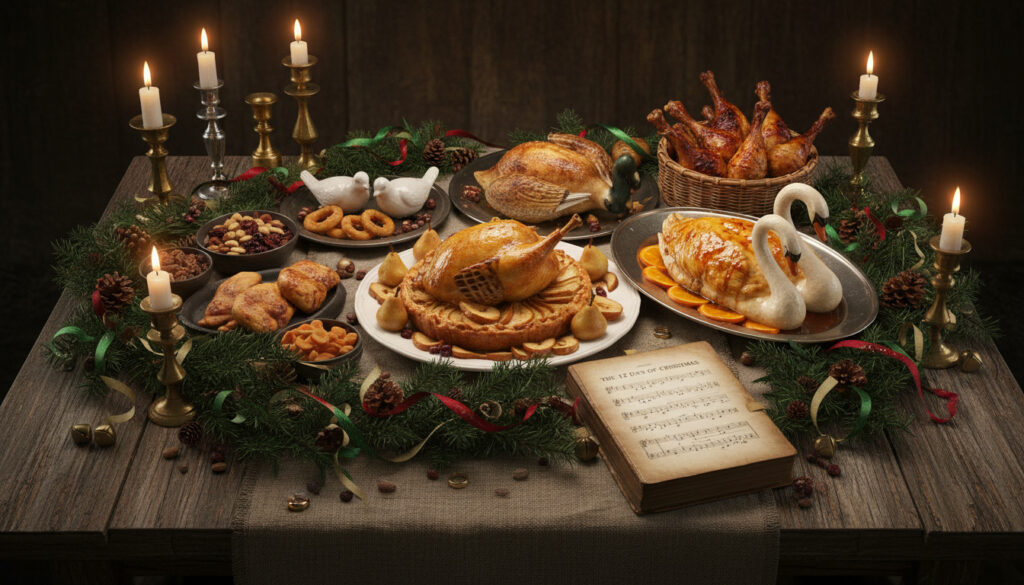
12 Days of Christmas Lyrics – Full Text, History and Myths Debunked
“The Twelve Days of Christmas” stands as one of the most recognizable cumulative carols in the English-speaking world, demanding precise recall of twelve escalating gifts delivered by a “true love” across the holiday period. The lyrics build repetitively, with each verse adding a new present while reciting all previous gifts in reverse order, creating a memory challenge that has entertained singers since at least the 18th century. Though commonly performed at modern holiday gatherings, the song retains complex layers of disputed history, debunked religious theories, and regional variations that separate folk tradition from documented fact.
The carol functions as both a nursery rhyme and a singing game, with the performer required to remember the sequence of gifts ranging from a partridge in a pear tree to twelve drummers drumming. Wikipedia notes that the earliest printed version appeared around 1780 in the English children’s book Mirth Without Mischief, though references to similar French counting songs date to the 1690s. Despite its antiquity, the modern melody and lyrical phrasing trace primarily to composer Frederic Austin’s 1909 arrangement, which standardized the tune most people recognize today.
While the song maintains a deceptively simple structure, interpreting the gifts’ significance has spawned widespread debate. A persistent theory claiming the items encode Catholic catechism lessons emerged in the late 20th century, yet historians lack evidence supporting this interpretation in any pre-1979 source, identifying it instead as a modern pedagogical invention. The carol survives through its structural elegance rather than hidden theological messaging, appearing in countless recordings, printable PDF collections, and seasonal playlists.
What Are the Full Lyrics to ‘The Twelve Days of Christmas’?
The complete lyric set follows a strict cumulative pattern where each day’s gift joins the procession of previous presents. Vocabulary.cl hosts the full repetitive verses showing how the song expands from a single item to a twelve-part inventory over the course of the melody.
- The cumulative structure results in 364 total gifts when summing all items across twelve days (one partridge, two doves, three hens, etc.)
- Frederic Austin’s 1909 arrangement established the melodic cadence and rhythm used in virtually all modern performances
- The phrase “my true love” refers to the gift-giver in the narrative, not necessarily a romantic partner
- Early English versions used “colly birds” (blackbirds) rather than “calling birds,” representing regional dialect variations
- The song’s structure derives from European counting games predating the Christian era
- No documentary evidence supports the Catholic catechism theory before a Canadian teacher proposed it in 1979
- The carol likely served secular entertainment rather than religious instruction during its early folk tradition phase
| Fact | Detail | Source Type |
|---|---|---|
| Geographic Origin | England (with possible French antecedents) | Historical Publication |
| Earliest Printed Version | c. 1780 in Mirth Without Mischief | Primary Source |
| Composer | Anonymous (folk tradition) | Musicology |
| Standard Arrangement | 1909 by Frederic Austin | Published Score |
| Genre Classification | Cumulative carol / nursery rhyme | Music Dictionary |
| Verse Structure | 12 verses with increasing repetitions | Lyric Analysis |
| Total Gift Count | 364 items cumulatively | Mathematical |
| Religious Code Theory | Debunked; originated 1979 | Historical Research |
| French Equivalent | “Douze jours de Noël” (1690s) | Comparative Folk Study |
| Modern Usage | Holiday performances, educational games | Cultural Observation |
What Is the Meaning Behind the Gifts in the Song?
Interpreters have long sought hidden significance in the sequence of birds, rings, and musicians, yet the weight of historical evidence suggests the items represent whimsical accumulation rather than theological encoding. Wikipedia documents how a popular theory emerged in the late 20th century claiming each gift corresponded to specific Catholic teachings, despite no pre-1979 sources supporting this interpretation.
Does Each Gift Represent Catholic Teachings?
The theory proposing religious symbolism assigns specific doctrines to each present: the partridge as Jesus Christ, the two turtle doves as the Old and New Testaments, the three French hens as theological virtues, continuing through twelve drummers representing points of Catholic doctrine. Proponents claimed these codes helped persecuted Catholics in 16th- and 17th-century England memorize catechism during Protestant rule. However, the Poetry Foundation and academic historians note the complete absence of this interpretation in historical documents from the era of alleged persecution.
Historians widely dismiss the Catholic catechism theory as a modern myth invented in 1979 by a Canadian teacher. The song predates the period of heavy English religious persecution and follows patterns common to secular European folk games, rendering the theological interpretation anachronistic and unsupported by primary sources.
Alternative Interpretations
Without religious encoding, the gifts likely represent a festive display of abundance and generosity appropriate to the Christmas celebration period. The birds (partridges, doves, hens, calling birds, geese, swans) reflect English culinary and poetic traditions, while the human participants (maids, ladies, lords, pipers, drummers) suggest a celebration growing in scale and merriment. The five gold rings remain the most materially valuable item, possibly representing jewelry or ornamental cookware rather than scriptural texts.
When Did the Song Gain Prominence?
The carol’s journey from obscure folk rhyme to global holiday standard occurred through distinct phases of publication, arrangement, and recording technology.
- : French references document “Douze jours de Noël,” suggesting early European cumulative song traditions.
- : Mirth Without Mischief prints the earliest known English version, targeting children as a memory game.
- : The song spreads through English oral tradition, accumulating regional variations in gifts and phrasing.
- : Frederic Austin publishes the standardized musical arrangement, fixing the melody and rhythm for subsequent generations.
- : A Canadian teacher proposes the Catholic catechism theory, subsequently debunked by historians but widely circulated in popular culture.
- : Digital distribution and streaming platforms maintain the song’s presence alongside printable lyric sheets and educational materials.
What Do We Know for Certain About the Lyrics?
Separating documented fact from speculative interpretation remains essential when examining this folk carol’s origins and significance.
Established Information
- The cumulative structure with twelve escalating gifts
- English origin with 1780 publication date
- Anonymous authorship and folk transmission
- Frederic Austin’s 1909 melodic standardization
- Connection to European counting game traditions
- Existence of French variants predating English print
Uncertain or Disputed
- Specific religious symbolism intended by original creators
- Exact composition date before 1780
- Whether French or English versions originated first
- Original melodic tradition prior to Austin’s arrangement
- The specific regional dialect of “colly” versus “calling”
- Whether the song served any instructional purpose
What Is the History and Origin of the 12 Days of Christmas?
Tracing the carol’s development reveals a murky path through English folk tradition, French antecedents, and Victorian preservation efforts that solidified the modern performance standard. The absence of a named author complicates definitive attribution, placing the work firmly within anonymous communal creation.
When Was the Song First Written?
Documentary evidence places the earliest English printing around 1780 in the children’s game book Mirth Without Mischief, though the oral tradition certainly predates this publication. Sources indicate possible French origins from the 1690s under the title “Douze jours de Noël,” suggesting the cumulative structure traveled across the Channel or developed independently in multiple European contexts. The 18th and 19th centuries saw the song proliferate through English oral tradition before formal musical arrangement.
Who Composed the Melody?
No individual composer created the original tune; rather, the carol evolved through countless folk renditions until Frederic Austin standardized the melody, harmony, and rhythmic phrasing in his 1909 publication. This arrangement established the familiar musical sequence that permits the cumulative lyrical structure to function effectively, with each day’s addition fitting the established metrical pattern. Austin’s version definitively replaced earlier melodic variants that may have differed significantly between villages and regions.
Evolution from Counting Games
The song belongs to a broader European tradition of cumulative counting rhymes designed as memory tests and entertainment for children. Similar structures appear in French, Scottish, and English nursery traditions, often featuring escalating numbers of animals, people, or objects. The classical music analysis emphasizes how the repetitive structure creates a musical round that becomes progressively more challenging to perform, explaining its enduring popularity as a party game.
What Are Popular Variations and Parodies?
Regional dialects, translation effects, and modern reinterpretations have generated numerous variants that alter specific gifts while maintaining the cumulative scaffolding. These variations demonstrate the song’s flexibility across cultural contexts and its capacity for humorous adaptation.
Regional Lyric Differences
The fourth day’s gift appears most frequently in disputed forms. The Poetry Foundation confirms that older English texts specified “colly birds,” using the regional term for blackbirds, rather than the modern “calling birds.” French variants substitute agricultural products such as cheeses, hams, and oxen for the English avian and human gifts, reflecting different cultural associations with holiday abundance. Some 19th-century English versions included cockerels, windmills, or rabbits, suggesting considerable fluidity in the canonical list before Austin’s standardization.
Linguistic analysis reveals that “colly” derives from the Old English word for coal, describing the black plumage of the birds. The shift to “calling birds” probably occurred through folk etymology, as singers unfamiliar with dialect terms substituted a more familiar descriptive word.
Modern Adaptations
Contemporary performers occasionally alter specific gifts for comic effect or topical relevance, though such parodies rarely achieve the canonical status of the traditional version. Cast of the Resident – Actors, Characters & Seasons Guide illustrates how modern serialized storytelling builds complex narratives across episodes, while Perry Como’s recording demonstrates how mid-20th-century artists adapted phrasing while retaining the core lyrical sequence. The cumulative structure invites endless substitution, with versions appearing that reference technology, politics, or workplace scenarios while maintaining the “true love” narrative frame.
For educators and carolers requiring physical copies, ABC Creative Music provides a PDF containing the complete lyrics with verse-by-verse repetitions suitable for printing and distribution during holiday gatherings.
What Are the 12 Days of Christmas?
The lyric reference corresponds to the festive Christian season spanning Christmas Day (December 25) through Epiphany (January 6), traditionally celebrated as the period between Christ’s birth and the arrival of the Magi. This twelve-day span represents the liturgical Christmas season in Western Christianity, distinct from the commercial Advent period preceding December 25. The song’s gifts arrive sequentially during this interval, with the partridge appearing on Christmas Day and the drummers concluding the festivities on Twelfth Night.
In English tradition, Twelfth Night marked the end of feasting and the removal of holiday decorations, though modern practice often compresses the twelve days into the period before Christmas rather than after. The cumulative gift-giving in the lyrics mirrors the medieval tradition of extending celebration across the liturgical season rather than concentrating observance on a single day. This temporal structure connects the carol to ancient agricultural cycle celebrations and the Roman Saturnalia, which similarly featured gift exchanges across multiple days.
What Do Historical Sources Reveal?
Primary documentation provides limited but specific details about the carol’s early existence and subsequent standardization.
On the first day of Christmas my true love sent to me
A partridge in a pear tree.— Mirth Without Mischief, c. 1780 (earliest English printing)
The gifts include: a partridge in a pear tree, two turtle doves, three French hens, four colly birds, five gold rings, six geese a-laying, seven swans a-swimming, eight maids a-milking, nine ladies dancing, ten lords a-leaping, eleven pipers piping, and twelve drummers drumming.
— Frederic Austin, 1909 arrangement (modern standardization)
Historians widely dismiss [the Catholic catechism theory] as a modern myth invented in 1979 by a Canadian teacher, with no evidence in pre-20th century sources; the song predates heavy persecution and matches secular folk patterns.
— Historical analysis, Wikipedia
Why Does the Song Remain Relevant?
The carol endures through its structural brilliance as a memory challenge and its adaptability to diverse performance contexts, from children’s classrooms to professional choral arrangements. While Cast of the Resident – Actors, Characters & Seasons Guide illustrates how modern serialized storytelling builds complex narratives across episodes, this Christmas carol similarly constructs complexity through iterative addition, creating a satisfying cognitive challenge that rewards mastery. Unlike television dramas, however, the song requires no technological mediation to transmit across generations.
Contemporary listeners continue to seek standardized lyrics for holiday gatherings, ensuring the tradition persists despite debunked theories about hidden meanings. Whether performed as a serious musical piece or adapted for parody, the cumulative structure provides a reliable framework for holiday entertainment that transcends specific cultural or religious interpretations.
Frequently Asked Questions
What does my true love give to me on the 12th day?
On the twelfth day, the narrator receives twelve drummers drumming, eleven pipers piping, ten lords a-leaping, nine ladies dancing, eight maids a-milking, seven swans a-swimming, six geese a-laying, five gold rings, four calling birds, three French hens, two turtle doves, and a partridge in a pear tree.
How many total gifts appear in the complete song?
The cumulative structure results in 364 total gifts: one partridge, three doves (two new plus one repeated), six hens (three new plus three previous), continuing through twelve days of arithmetic progression.
Did the song originate as a secret Catholic catechism?
No. Historians dismiss this theory as a modern invention from 1979. No evidence exists in pre-20th century sources linking the gifts to Catholic doctrine, and the song follows secular folk patterns predating English religious persecution.
What is the difference between calling birds and colly birds?
“Colly” derives from Old English meaning “coal,” referring to blackbirds. Early English versions used “colly birds,” but modern singers often substitute “calling birds” through folk etymology, substituting an unfamiliar dialect term with a descriptive alternative.
Is there a printable PDF of the lyrics available?
ABC Creative Music offers a printable PDF containing the full lyrics with proper verse repetitions suitable for educational or performance use.
What is the earliest known publication of the lyrics?
The earliest English printing appeared around 1780 in Mirth Without Mischief, a children’s game book, though the oral tradition certainly existed earlier and French variants date to the 1690s.
How does the French version differ from the English?
French variants titled “Douze jours de Noël” often substitute agricultural products such as cheeses, hams, and oxen for the birds and people listed in English versions, reflecting different cultural gift traditions.
More related posts
 Emile Heskey: From Liverpool Star to Leicester City Women Coach
 What Is the Newest iPhone? iPhone 17 Series 2025
 Christ Redeemer Statue: Guide, History & Key Facts
 Robin Gunningham: Is He Really Banksy? 2026 Investigation
 Princess Eugenie Beatrice Royal Fate: Titles, Protection
 Where Is Kenneth Noye Now? M25 Killer Update
 Matt Goodwin: Political Views, Party Support, and Bio
 Khloe Kardashian: Kids, Net Worth, Autosexual Sister