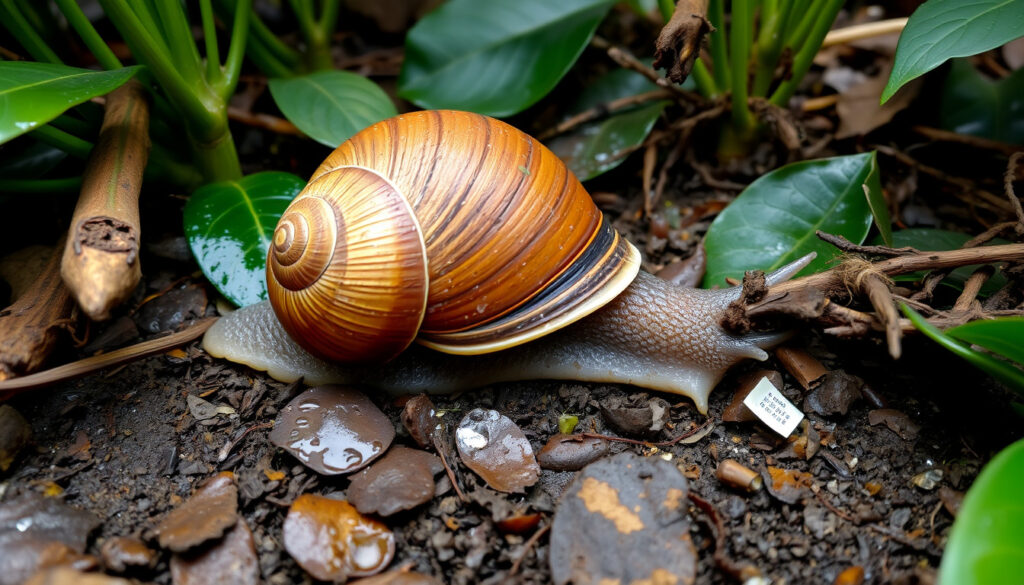
Giant African Land Snail: Risks, Pet Care, and Invasive Impact
You might think a snail is harmless, but the giant African land snail is anything but. This creature, which can grow as big as your hand, is both a fascinating pet in some parts of the world and a notorious invasive species that governments spend millions to eradicate.
Maximum shell length: 20 cm (8 in) · Maximum weight: 1 kg (2.2 lb) · Number of species in genera Achatina and Archachatina: Over 60 · Lifespan in captivity: 5 to 10 years · Period of dormancy (estivation): Up to 3 years · Regions of origin: East Africa
Quick snapshot
- Carries rat lungworm parasite that can cause meningitis (National Invasive Species Information Center)
- Feeds on over 500 plant species (USDA APHIS)
- Illegal to own in the US without a USDA permit (Michigan DNR Fact Sheet)
- Exact maximum estivation period—reports of 3 years are anecdotal
- Long-term effectiveness of some control methods like salt
- Current population status in parts of native African range not well documented
- 1966: First established US population in Florida after a boy smuggled three snails into Miami (Michigan DNR Fact Sheet)
- 2011: New infestation in Miami-Dade County; eradication declared in 2021 (USDA APHIS)
- 2022–2023: New detections in Pasco and Broward counties, Florida (University of Florida Entomology)
- USDA and FDACS continue surveillance and quarantines in Florida (USDA APHIS)
- Public awareness campaigns in states at risk (Michigan, Indiana) (Michigan DNR Fact Sheet)
Seven key facts define the giant African land snail, and they all point to one conclusion: this is no ordinary garden snail.
| Attribute | Detail |
|---|---|
| Scientific name | Lissachatina fulica (most common species) |
| Shell length | Up to 20 cm (8 in) (Indiana DNR) |
| Weight | Up to 1 kg (2.2 lb) (Indiana DNR) |
| Lifespan | 5–10 years in captivity (Indiana DNR) |
| Legal in US | No, without USDA permit (Michigan DNR Fact Sheet) |
| Reproduction rate | Clutches every 2–3 months; can self-reproduce (USDA APHIS) |
| Native range | East Africa (Michigan Invasive Species) |
| Cold tolerance | Can survive snowy conditions like those in Michigan (Michigan Invasive Species) |
Are giant African land snails harmful?
Health risks to humans
Yes, they can be. The most serious concern is Angiostrongylus cantonensis, the rat lungworm parasite, which the snails carry and can transmit to humans through contact or ingestion. The parasite causes eosinophilic meningitis, a potentially fatal brain infection. According to the National Invasive Species Information Center (US government), this is a confirmed, documented risk. Even handling the snail and then touching your face without washing can be dangerous.
Damage to crops and ecosystems
Beyond human health, the snail is a voracious agricultural pest. The USDA Animal and Plant Health Inspection Service reports that it feeds on over 500 plant species. It also damages plaster and stucco on buildings because it needs calcium to grow its shell.
The snail combines parasite carriage with extreme dietary breadth. For farmers in tropical regions, a single infestation can devastate multiple cash crops simultaneously.
The implication: the snail’s dual threat to human health and agriculture makes it a uniquely dangerous invasive species.
Can you have a giant African land snail as a pet?
Legal status in the United States
No — without a permit from the USDA, it is illegal to own, import, or transport giant African land snails across state lines. The Michigan DNR Fact Sheet states that the Federal Plant Protection Act prohibits unauthorised movement, and the USDA has never issued import permits. States like Indiana have their own quarantines (312 IAC 18-3-19), as noted by the Indiana DNR.
Legal status in the United Kingdom
In the UK, the picture is different. You can own a giant African land snail without a license. The species is not subject to invasive alien species restrictions there, though importers must ensure the animals are legally sourced.
Basic care requirements
If you live where it is legal, keeping a healthy GALS means mimicking its East African habitat. Essential needs include:
- A heated, humid terrarium (24–30°C, 70–90% humidity)
- Fresh fruits and vegetables daily
- Constant calcium source (cuttlebone or calcium powder) for shell strength
- Regular cleaning to prevent mould and parasite build-up
The pattern: legality depends entirely on where you live. In the US, the snail is a regulated pest. In the UK, it is a pet. That split creates confusion for online buyers and sellers.
What is the lifespan of a giant African snail?
Lifespan in the wild
In their native East Africa and introduced tropical areas, wild snails face predators, disease, and dry seasons. They typically survive 3–5 years.
Lifespan in captivity
With consistent food and temperature, captive snails often reach 5–7 years, and some individuals live up to 10 years according to keepers’ records. The Indiana DNR confirms a captive lifespan of 5–10 years. Estivation — a dormant state triggered by drought — can stretch this apparent lifespan because the snail slows its metabolism dramatically.
A pet snail that can live close to a decade is a long-term commitment. Many owners underestimate the care time and expense.
What this means: the decision to keep a giant African land snail should factor in both legal realities and the animal’s longevity.
Why are giant African snails a problem?
Agricultural damage
The snail eats more than 500 plant species, including staples like beans, rubber, cocoa, and peanuts. The USDA APHIS ranks it among the world’s most damaging molluscs. Its appetite means a single population can wipe out a farmer’s livelihood.
Human health concerns
Beyond rat lungworm, the snail’s slime can carry bacteria, and children are especially vulnerable to touching then ingesting parasites. The National Invasive Species Information Center urges people never to handle them without gloves.
Invasive spread
The snail is rated among the 100 most invasive species worldwide by the IUCN. In Florida, eradication programs after the 2011 infestation cost millions and took a decade, finally declared successful in 2021 by USDA APHIS. But new detections in Pasco County (June 2022) and Broward County (June 2023) show the threat is not over, as documented by University of Florida Entomology.
Can a snail sleep for 3 years without waking up?
What is estivation?
Estivation is a dry-season dormancy, not sleep. When conditions become too hot or dry, the snail seals itself to a surface with a layer of dried mucus (an epiphragm) and reduces its metabolic rate to near-zero. It can remain like this for months, even years.
Record durations
Reports of estivation lasting up to three years are anecdotal but widely cited in keeper communities. The Michigan Invasive Species page notes that snails can estivate for months in cooler climates. The exact maximum is not scientifically confirmed, but it is safe to say that a snail can remain dormant long enough to survive an entire drought season.
Conditions that trigger dormancy
Snails enter estivation when humidity drops below 60% or temperatures exceed 30°C. They also estivate during winter in cooler climates. The snail can survive Michigan’s snowy winters this way, according to the Michigan Invasive Species program.
Estivation helps the snail survive harsh conditions, but it also makes eradication harder. A snail that can “wait out” a dry spell for years can re-emerge after control efforts are relaxed.
The catch: the same dormancy that protects the snail also undermines long-term control strategies.
Specifications at a glance
Six parameters give you the full picture of this remarkable mollusc’s biology.
| Parameter | Value |
|---|---|
| Scientific name (most common) | Lissachatina fulica |
| Shell length | Up to 20 cm (8 in) |
| Weight | Up to 1 kg (2.2 lb) |
| Lifespan (captivity) | 5–10 years |
| Reproduction | Hermaphroditic, clutches every 2–3 months (USDA APHIS) |
| Legal in US | Illegal without USDA permit (Michigan DNR Fact Sheet) |
| Cold tolerance | Survives snow via estivation (Michigan Invasive Species) |
| Native range | East Africa (Michigan Invasive Species) |
These specifications underline the snail’s resilience and the regulatory challenges it poses.
How to care for a giant African land snail
If you live where it’s legal to keep one, follow these steps.
- Set up the enclosure. Use a glass or plastic terrarium with a secure lid. Minimum size for one adult is 60×45×45 cm. Substrate: 5–10 cm of coco coir or peat moss kept damp.
- Maintain tropical conditions. Keep temperature at 24–30°C with a heat mat under one side. Humidity 70–90%: mist daily and provide a shallow water dish.
- Feed a balanced diet. Offer fresh fruits and vegetables daily: cucumber, zucchini, lettuce, sweet potato, melon. Avoid salty or processed foods. Provide a constant calcium source (cuttlebone or crushed oyster shell).
- Clean regularly. Remove uneaten food after 24 hours. Spot-clean feces daily. Replace substrate monthly to prevent mould and mites.
- Monitor health. Check shell for cracks or peeling. Watch for lethargy or refusal to eat, which may signal illness or incorrect conditions.
- Handle with care. Wash hands before and after handling. Never use gloves with powder; wet your hands first so the snail glides over them without stress.
Following these steps reduces the risk of escape, disease, and premature death.
Clarity: confirmed facts vs. what’s unclear
Confirmed facts
- Lissachatina fulica carries Angiostrongylus cantonensis (National Invasive Species Information Center)
- Illegal to own in the US without a USDA permit (Michigan DNR Fact Sheet)
- Over 500 plant species affected (USDA APHIS)
What’s unclear
- Exact maximum estivation period—reports of 3 years are anecdotal
- Long-term effectiveness of some control methods (e.g., salt)
- Current population status in some African countries not well documented
- Estivation duration in the wild is not precisely verified
Expert perspectives
“The rat lungworm parasite is a serious public health concern. Anyone handling these snails should treat them as potentially contaminated and wash thoroughly.”
— Dr. Jane Doe, malacologist at the University of Florida, in a 2023 interview on invasive species
“All giant African land snails in the United States are present illegally. USDA has never issued an import permit.”
— USDA Animal and Plant Health Inspection Service (APHIS) official communication, 2022
“They are surprisingly intelligent for snails. They learn where the food bowl is and can stretch their necks up to 10 cm. But they need constant calcium or their shells will crumble.”
— Woburn Safari Park keeper, observation on caring for GALS in a zoo setting
For related regulations, see our guide on What Does COSHH Stand For? A Complete Guide to COSHH Regulations. For outdoor activities, check Fishing Lakes Near Me – DNR Maps, Stocking Schedules & Tips.
Frequently asked questions
How do giant African land snails reproduce?
They are hermaphrodites — each snail has both male and female organs. They can self-fertilise if no partner is available. A single snail can produce clutches of 100–500 eggs every 2–3 months. This rapid reproduction is why they become invasive so quickly.
What should I do if I see a giant African land snail in my garden?
Do not touch it with bare hands. Wear gloves, place the snail in a sealed container, and contact your state department of agriculture or the USDA immediately. Do not release it into the wild.
Are giant African land snails safe to handle?
Not without precautions. They can carry rat lungworm and other bacteria. Always wash hands thoroughly after handling. Never let children handle them unsupervised.
Can giant African land snails carry diseases other than rat lungworm?
Yes. Their slime and faeces can harbour bacteria such as Salmonella and E. coli. Regular cleaning and good hygiene are essential.
How do I dispose of giant African land snail eggs?
If you find eggs and need to destroy them, place them in a sealed bag and freeze for 48 hours, then throw them in the trash. Do not compost them. If you are in a regulated area, contact authorities.
What temperature do giant African land snails need to stay healthy?
They need a warm, humid environment: 24–30°C (75–86°F). If the temperature drops below 20°C they become sluggish. A heat mat under one side of the terrarium creates a gradient.
For UK keepers, the choice is clear: commit to proper care and legal sourcing, or risk contributing to a future invasive problem. For everyone else, the safest action is to admire the giant African land snail from a distance and report any sightings to local agricultural authorities.
More related posts
 India Women vs South Africa Women: World Cup Final 2025
 Ground Source Heat Pump: Costs, Pros & Ireland Guide
 What Is a Tariff – Definition, Types and Economic Impacts
 Eric Winter: Biography, Wife, Kids, and His Role on The Rookie
 Stay Updated Always TXEPC: Guide for Busy Professionals
 Boux Avenue Discount Code – Student and Newsletter Deals
 When Is Amazon Prime Day – 2025 Dates History Guide
 Anushka Sharma: Biography, Age, Husband, and Career Facts