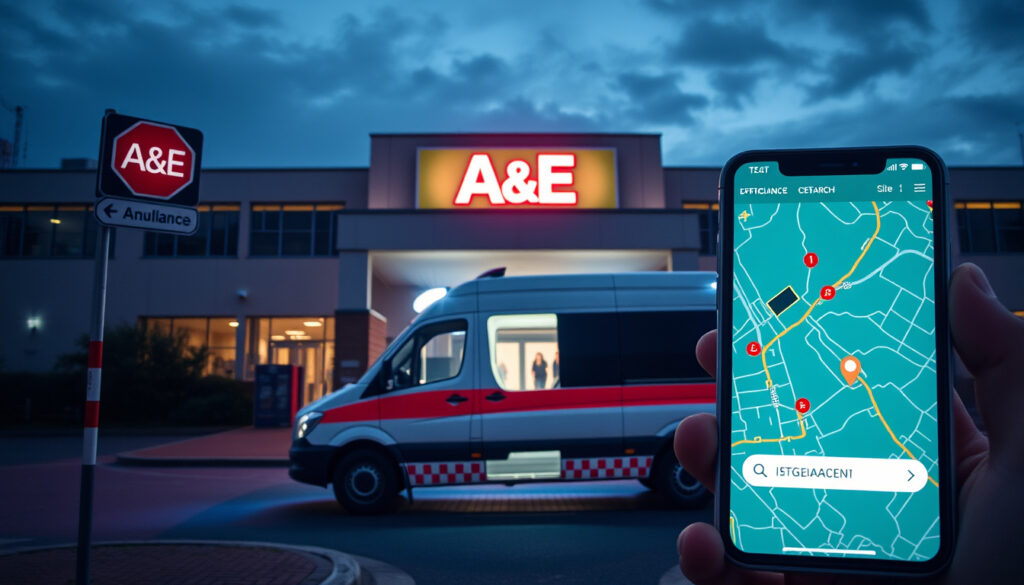
Nearest A&E Near Me: When to Go and How to Find It
Choosing between a trip to A&E or an alternative urgent care service often comes down to where you live and what’s wrong — and the cost difference between the UK and Ireland is the sharpest divide. This guide compares the NHS and HSE systems so you know what to expect before you walk through those doors.
Annual A&E attendances in England (2022/23): 14.3 million ·
Average waiting time in English A&E (2022): 4 hours 34 minutes ·
Public ED visits in Ireland (2022): 1.2 million ·
Cost of a public ED visit in Ireland: €100
Quick snapshot
- Life-threatening conditions like severe chest pain, stroke symptoms, and major trauma – NHS (UK health service)
- Heavy bleeding, choking, seizures – NHS (UK health service)
- NHS A&E accepts walk-ins – NHS (UK health service)
- No GP referral needed for NHS A&E (NHS (UK health service))
- HSE public EDs accept walk-ins – HSE (Ireland’s health authority)
- €100 charge for a public ED visit without a GP referral – Citizens Information (Irish public services guide)
- Free for medical card holders – Citizens Information (Irish public services guide)
- Call 111 for advice – NHS (UK health service)
- Use the NHS online hospital finder – NHS (UK health service)
- Search on the HSE website for emergency departments and injury units – HSE (Ireland’s health authority)
Five facts capture the key numbers across both systems, one pattern: the cost difference between UK and Ireland is the sharpest divide.
| Fact | Value |
|---|---|
| A&E attendance UK 2022/23 | 14.3 million – NHS England (statistical authority) |
| Average wait time in England | 4 hours 34 minutes (2022) – NHS England (statistical authority) |
| Ireland ED visits 2022 | 1.2 million |
| Cost of public ED in Ireland | €100 – Citizens Information (Irish public services guide) |
| GP card holders | Free GP visits but not ED – Citizens Information (Irish public services guide) |
The implication: UK residents pay nothing at the point of care, while Irish patients face a steep €100 charge unless they have a medical card.
How do I know whether to go to A&E?
What conditions are considered life-threatening?
The NHS (UK’s national healthcare service) lists A&E as the place for serious injuries and life-threatening emergencies. That includes heavy bleeding, choking, seizures, severe chest pain, and stroke symptoms. HSE (Ireland’s health service executive) uses the same definition: emergency departments are for serious illness or injury needing urgent treatment.
What is the difference between A&E and urgent care?
Urgent treatment centres (UTCs) and minor injury units handle non-life-threatening problems like sprains, cuts, and infections. The NHS (UK health service) advises using these for conditions that need prompt attention but are not emergencies. In Ireland, the HSE (Ireland’s health authority) recommends local injury units for minor injuries like broken bones and burns.
When should I call 111 instead?
If you’re unsure about your symptoms, NHS 111 can guide you. The NHS (UK health service) says 111 is for when you need urgent medical help but it’s not a 999 emergency. In Scotland, NHSGGC (Greater Glasgow and Clyde health board) recommends calling NHS24 on 111 when GP services are closed.
Can I go to A&E without a referral?
Do I need a GP referral?
No. The NHS (UK health service) confirms you can walk into any A&E without a GP referral. The HSE (Ireland’s health authority) says the same for public emergency departments.
Can I walk into any A&E department?
Yes, within the NHS and HSE public systems. However, NHS (UK health service) advises checking opening hours and specialist services on your local hospital’s page, as some departments may have different hours.
What about private hospitals in Ireland?
Private hospitals in Ireland often require pre-authorisation or insurance details. These policies are set by individual insurers and facilities, so it’s best to call ahead.
Do you have to pay for A&E in Ireland?
What are the costs for public ED visits in Ireland?
Public emergency departments in Ireland charge €100 per visit for those who are ordinarily resident and do not have a medical card or GP referral. Citizens Information (Irish public services guide) states that non-urgent care may also involve a fee.
What are the costs for private ED visits?
Private ED costs vary widely depending on the hospital and insurance plan. Some insurers cover the full cost, while others require a co-payment.
How does a GP card affect costs?
A GP card covers GP visits but not emergency department fees. Only holders of a full medical card get free ED visits in Ireland, according to Citizens Information (Irish public services guide).
The €100 charge applies unless you have a medical card or a GP referral. Without that, even a short wait can cost you.
What this means: Irish residents without a medical card face a financial barrier that UK patients don’t, making the choice of where to seek care a matter of both health and wallet.
Does a GP card cover A&E?
What is a GP card in Ireland?
A GP card entitles you to free visits to a general practitioner. It does not cover hospital charges. The Citizens Information (Irish public services guide) clarifies that only a medical card waives the ED fee.
What costs are covered by a GP card?
GP cards cover consultations with your family doctor and some related services. They do not cover prescriptions, other specialists, or emergency department fees.
Do GP cards cover private A&E?
No. Private emergency departments are not covered by GP cards. You would need private health insurance or pay out of pocket.
Where can I find the nearest A&E or urgent care centre?
How to find A&E on the NHS website
The NHS (UK health service) offers a hospital search tool where you enter your postcode to find the nearest A&E, urgent treatment centre, or minor injury unit. The results show opening hours, services, and performance ratings.
How to find urgent care in Ireland on the HSE site
The HSE (Ireland’s health authority) provides a similar tool to locate emergency departments, local injury units, and other urgent care services by county or town.
What are the alternatives to A&E?
- Walk-in centres (NHS) for minor ailments
- Minor injury units (NHS and HSE) for sprains, fractures, burns
- Urgent treatment centres (NHS) for non-life-threatening emergencies
- Private urgent care clinics like Laya and Irish Life ExpressCare in Ireland
The HSE (Ireland’s health authority) strongly advises not going to an ED for minor injuries that can be treated elsewhere.
Choosing the right service saves you time and money. A visit to a UTC or injury unit can cut wait from hours to minutes and avoid the €100 charge in Ireland.
Upsides and downsides of A&E
Upsides
- Immediate access to advanced diagnostics and specialist care
- Free at the point of use for UK residents
- Available 24 hours in most locations
- No referral needed for NHS or HSE public EDs
Downsides
- Long wait times – average 4 hours 34 minutes in England (2022) – NHS England (statistical authority)
- €100 charge for public ED in Ireland without a medical card – Citizens Information (Irish public services guide)
- Private ED costs vary and may not be covered
- Overcrowding can lead to corridor care
Steps to find and access the right emergency care
- Assess your symptoms. Are they life-threatening? If yes, call 999 or 112 (Ireland) or go to the nearest A&E.
- Call 111 (NHS) or 112 (HSE) if unsure. They can direct you to the right service.
- Use online tools. NHS hospital finder or HSE find a hospital to locate the nearest appropriate facility.
- Consider alternatives. Urgent treatment centres, minor injury units, or pharmacies may be faster and cheaper.
- Bring ID and any relevant documents. In Ireland, bring your medical card if you have one, or insurance details.
- Prepare for a wait. Bring water, snacks, and a phone charger — especially in busy periods.
What’s confirmed and what’s unclear
Confirmed facts
- NHS A&E is free for UK residents – NHS (UK health service)
- Public ED in Ireland charges €100 per visit unless you have a medical card or GP referral – Citizens Information (Irish public services guide)
- NHS 111 can help you find the right service – NHS (UK health service)
What’s unclear
- Private A&E costs vary widely and are not standardised
- Future changes to the NHS 111 First program
- Exact wait times for specific hospitals – they fluctuate by season and demand
Expert perspectives
A&E is for serious injuries and life-threatening emergencies, not minor problems.
NHS England (UK health authority)
If it’s not life-threatening, consider a GP, GP out-of-hours service, pharmacy, or local injury unit before an emergency department.
HSE (Ireland’s health authority)
For a minor illness such as a cough or high temperature, a GP or pharmacist can help.
Summary
The key takeaway is that knowing when to go to A&E and when to choose an alternative can save you hours and money. For UK residents, the NHS provides free emergency care, but the 111 service is a valuable first step. In Ireland, the €100 charge makes it especially important to consider injury units or a GP visit first. For anyone needing the nearest A&E, the online tools from the NHS (UK health service) and HSE (Ireland’s health authority) are the fastest ways to find what’s open near you. The pattern is clear: UK residents walk in free, while Irish patients must navigate a €100 charge — and that difference should drive your decision about where to go first.
businessinsider.com, nhslanarkshire.scot.nhs.uk, kingsfund.org.uk, pmc.ncbi.nlm.nih.gov
For a more detailed guide on finding nearest A&E services and understanding wait times, check out this comprehensive resource.
Frequently asked questions
What should I bring to A&E?
Bring photo ID, your medical card (if you have one), a list of current medications, and any relevant medical history. In Ireland, bring proof of residency if you don’t have a medical card.
Can I bring someone with me?
Yes, most A&E departments allow one adult companion. However, some may restrict visitors due to space or infection control.
How long will I wait?
Wait times vary. In England, the average was 4 hours 34 minutes in 2022, according to NHS England (statistical authority). Urgent cases are seen faster.
Is A&E open 24 hours?
Most major A&E departments are open 24/7, but some urgent treatment centres and minor injury units have set hours. Check the NHS or HSE website for local hours.
Can I go to A&E if I have no insurance?
Yes, in the UK all A&E care is free regardless of insurance status. In Ireland, you may be charged €100 unless you have a medical card or GP referral.
What happens after I arrive at A&E?
You’ll be triaged by a nurse who assesses your condition. Based on urgency, you may be seen immediately or asked to wait. Treatment is provided, and you may be discharged, admitted, or referred.
Can I be turned away from A&E?
Public A&E departments cannot turn you away for emergency conditions. They may advise you to visit a different service for non-urgent issues, but they will still assess you.
Related reading
More related posts
 Chris Robinson: Biography, Net Worth, and Kate Hudson Marriage
 India Women vs South Africa Women: World Cup Final 2025
 Michelle Collins: British Actress vs American Comedian
 Stranger Things Season 5 Episode Lengths: Official Runtimes
 Livi Sheldon: Nationality, Age, Height and Gladiators Facts
 Compare the Market Insurance – Reviews, Rewards and Savings
 Translate English to German: Best Free Tools & Tips
 General Knowledge Quiz with Answers – Questions for Every Occasion